Plaskon Radios

Bakelite and Catalin get most of the attention, but Plaskon radios have some of the best designs and colors.  Plaskon was molded with more detail than Catalin, and could be colorful without being painted like Bakelite.  Below are some examples of radios made out of Plaskon.

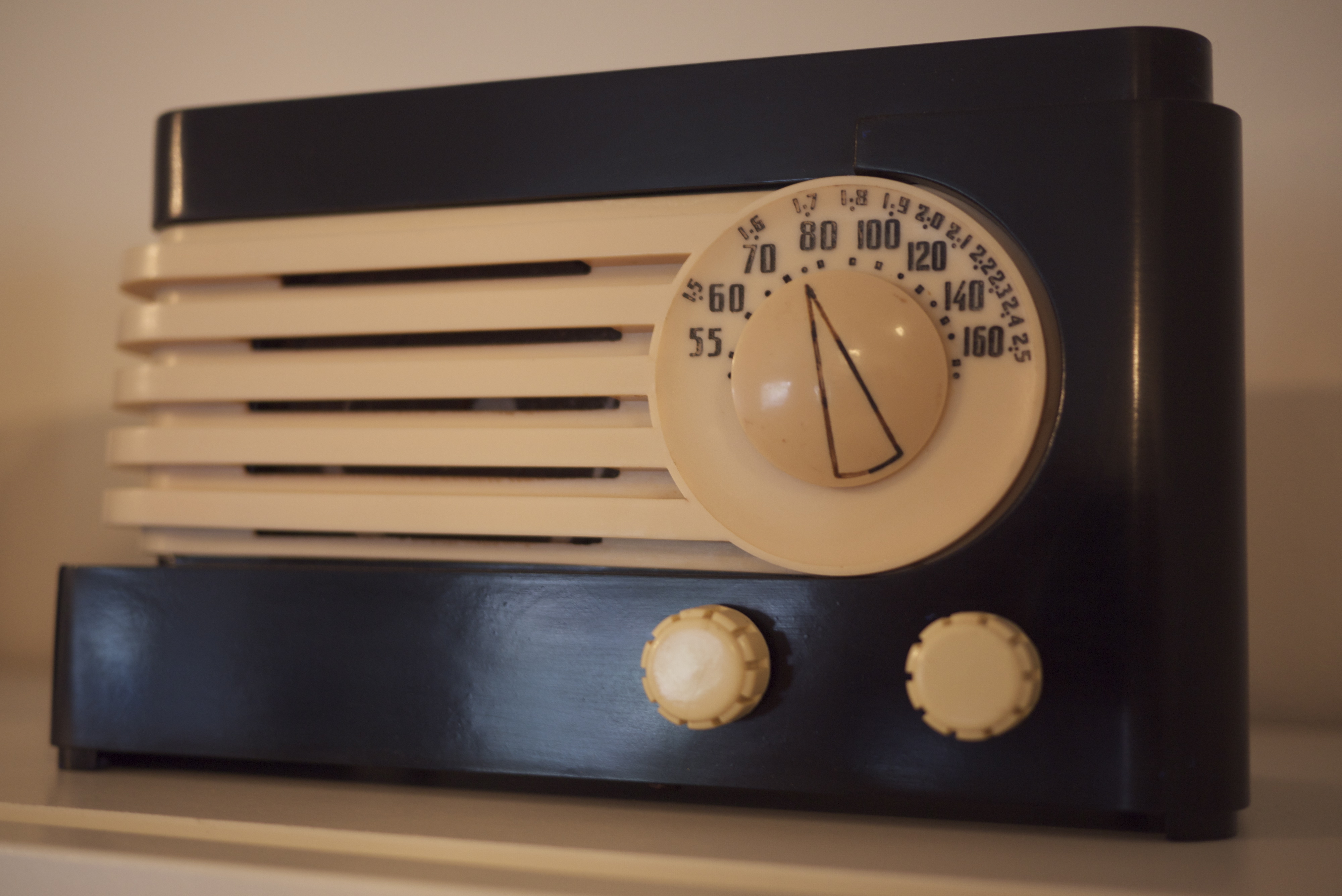
An elegant ivory Plaskon Kadette model 40 “Jewel” from 1935.  It’s a small radio, about 7 1/2″ wide by 5 1/2″ high.
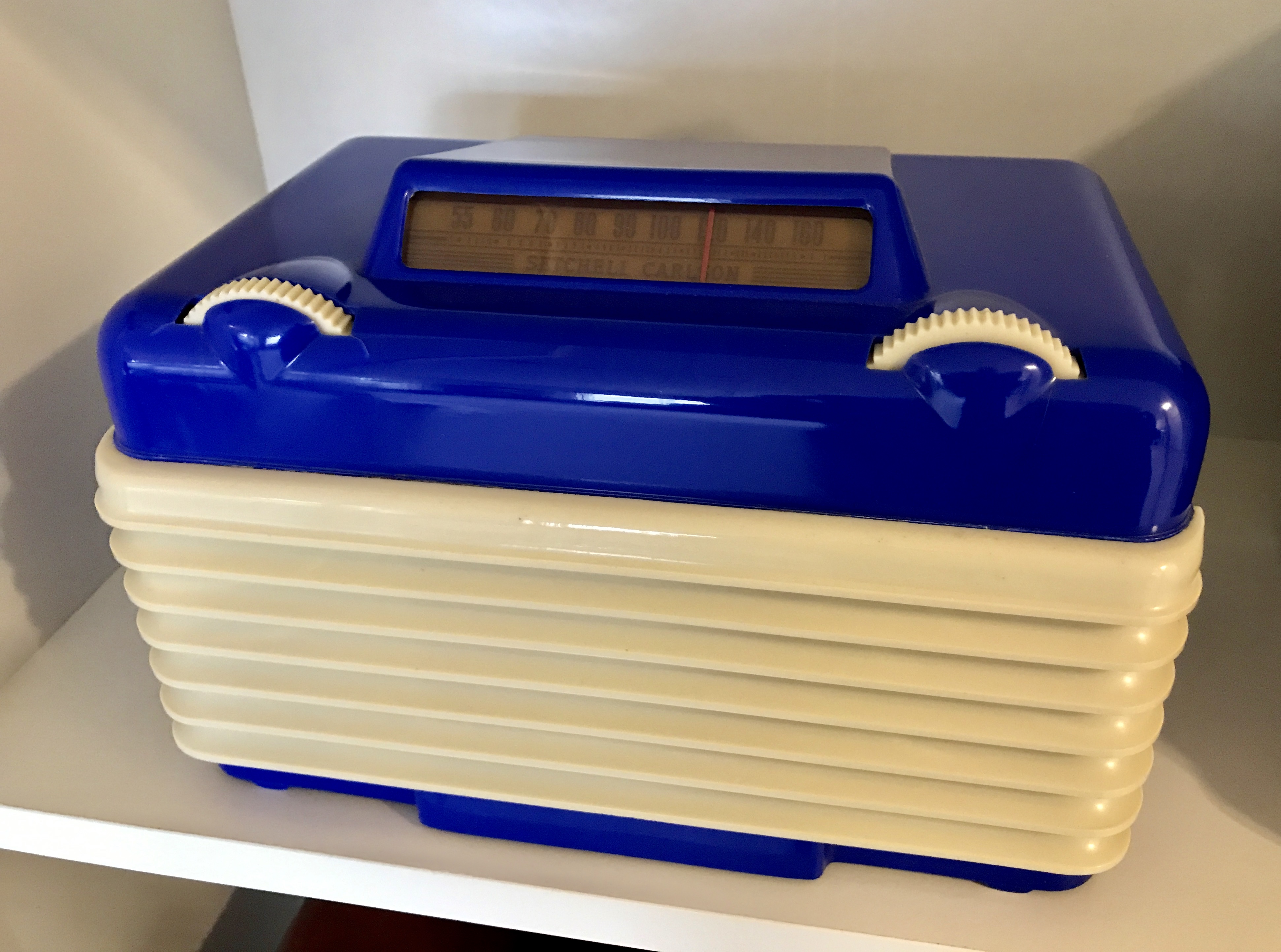
Here’s a rare cobalt blue Plaskon 1946 Setchell Carlson model 416.  Sometimes people paint other “Frog Eyes” in these colors, but this is an original model made of blue and ivory Plaskon (not painted).
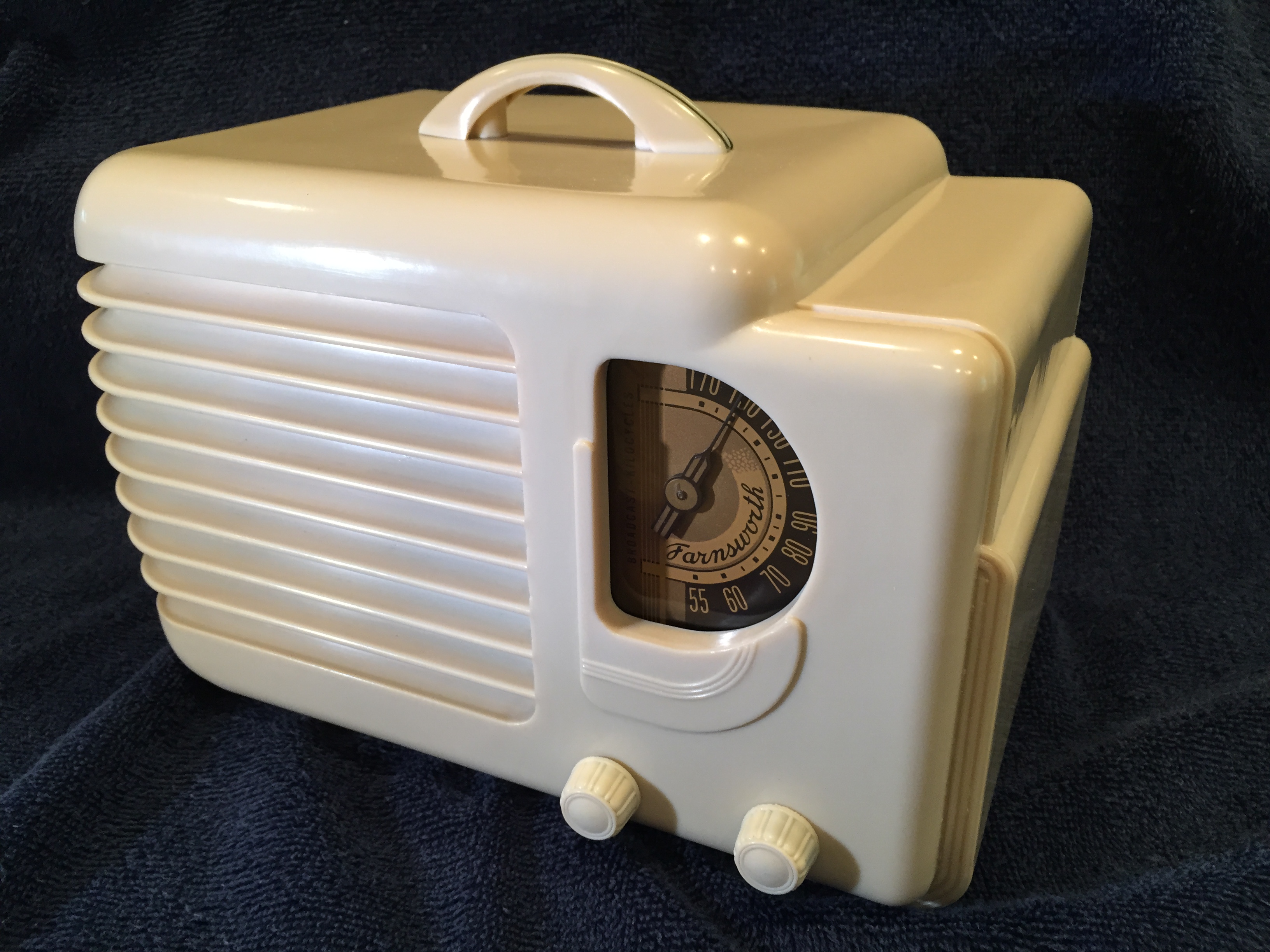
The 1939 Farnsworth AT-11 “D-Dial” is usually seen in brown Bakelite, but the details of the design show up best in ivory Plaskon.
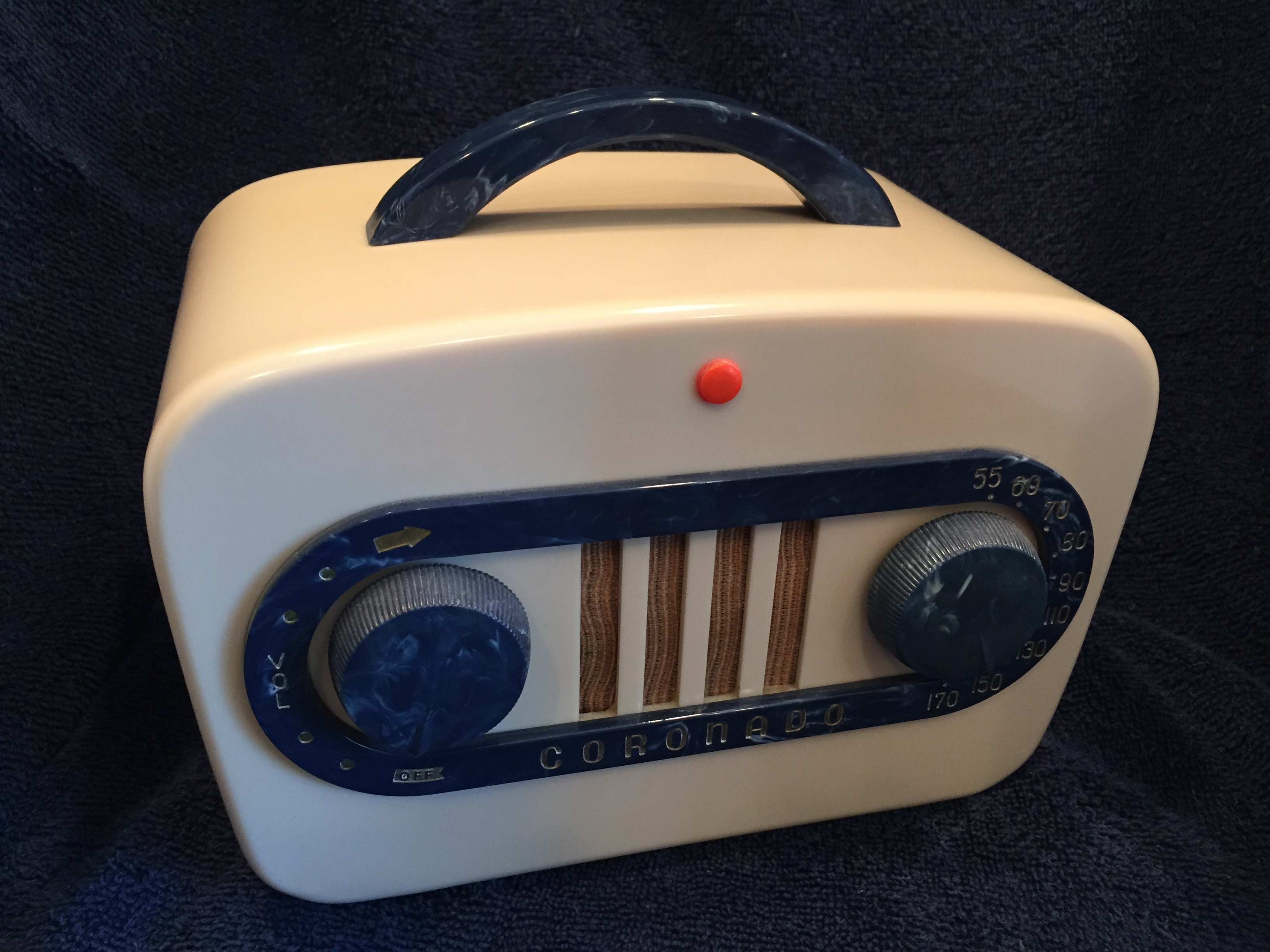
Here’s the Plaskon version of a 1947 Coronado “Racetrack”, model 43-8190.  It’s usually found in painted Bakelite.  The trim is a swirled blue polystyrene plastic that looks similar to Catalin.
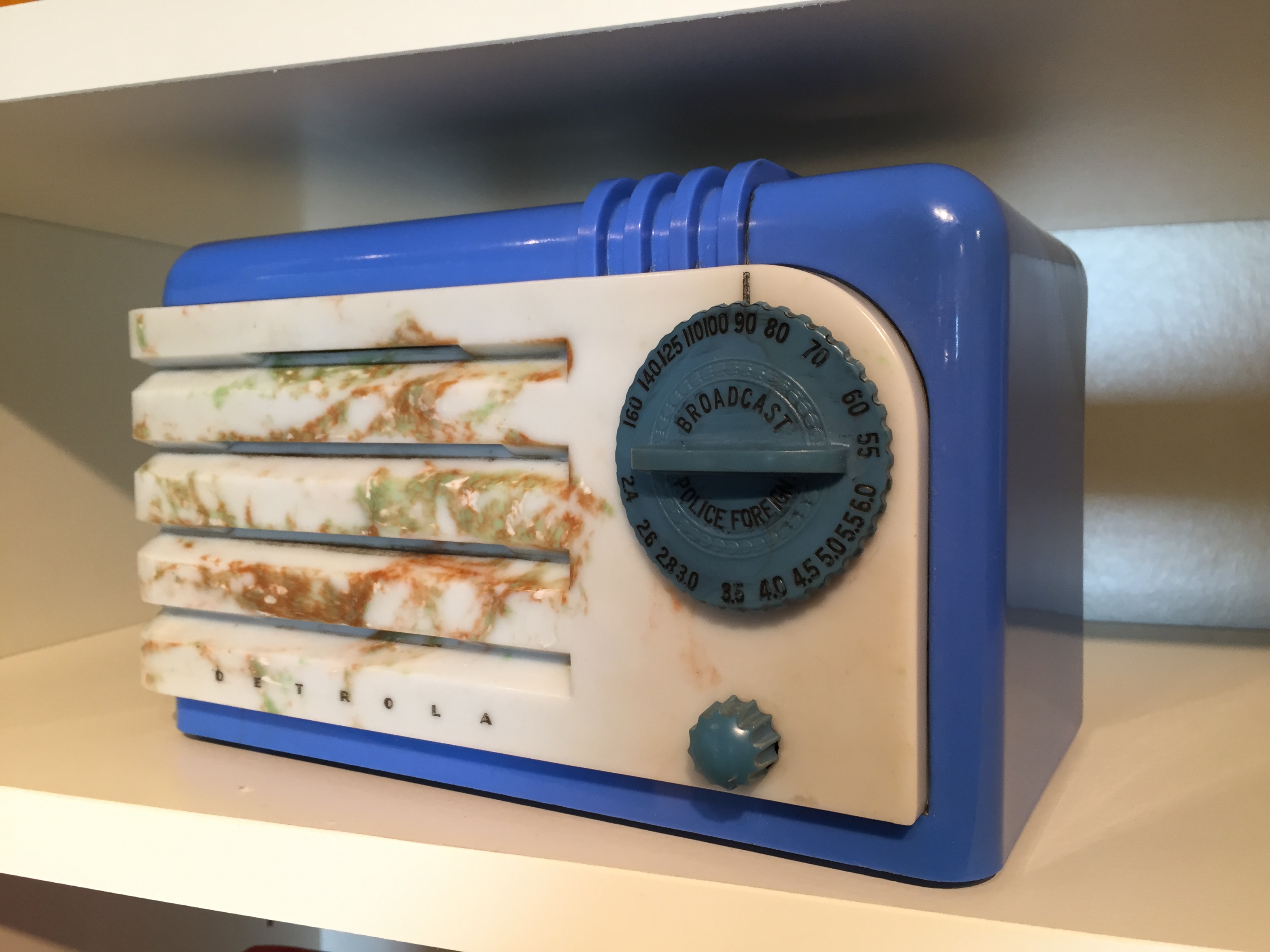
This is another radio with a combination of plastics.  The main case is blue Plaskon, the front is Beetle Plastic, and the knobs seem to be Tenite.  It’s a 1939 Detrola model 219 Super Pee Wee.
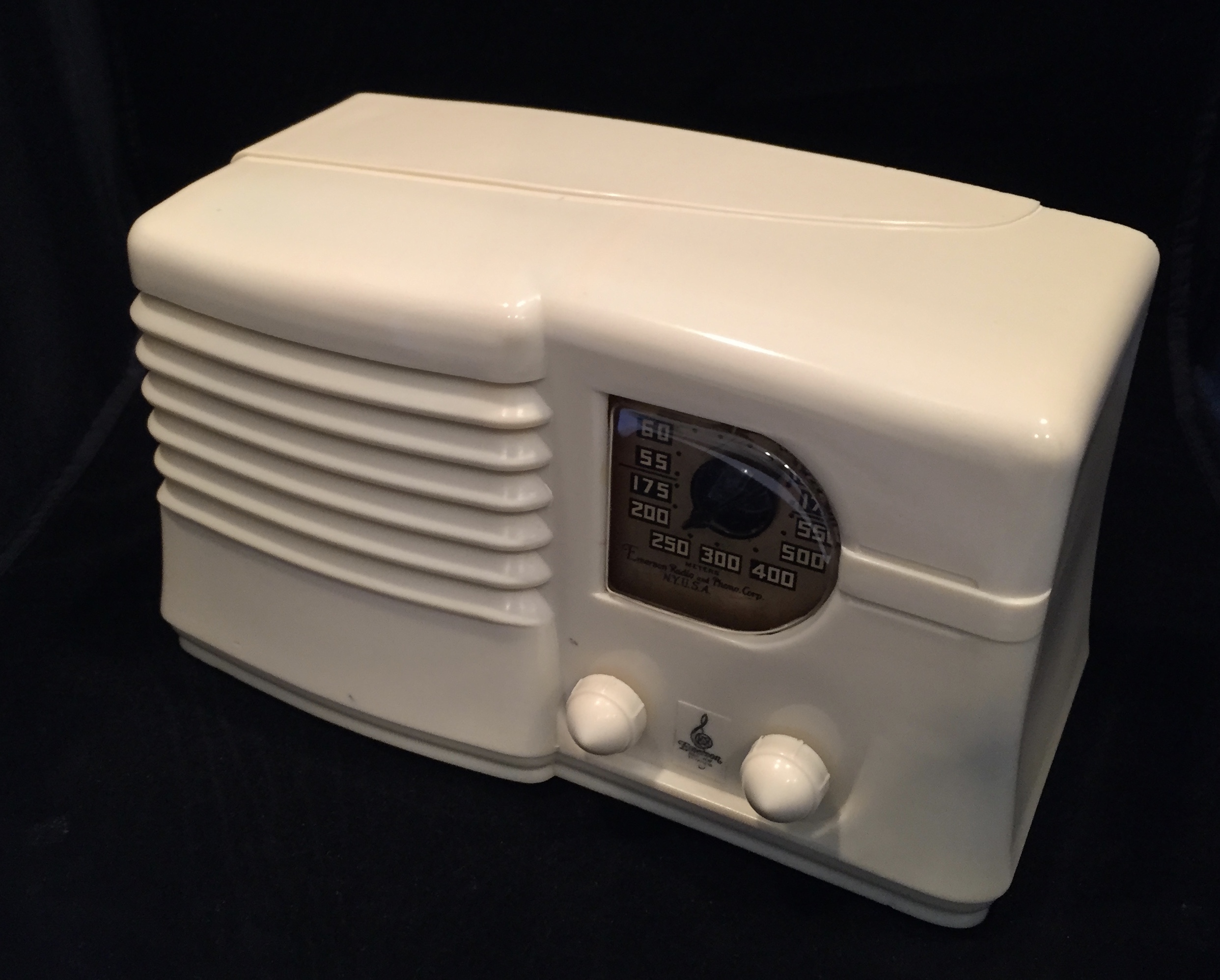
Another small radio is the 1938 Emerson 246 D-Dial.  It has a very stylized Plaskon case, giving it a really cool look.  It uses the same Emerson chassis as the Catalin Little Miracle.
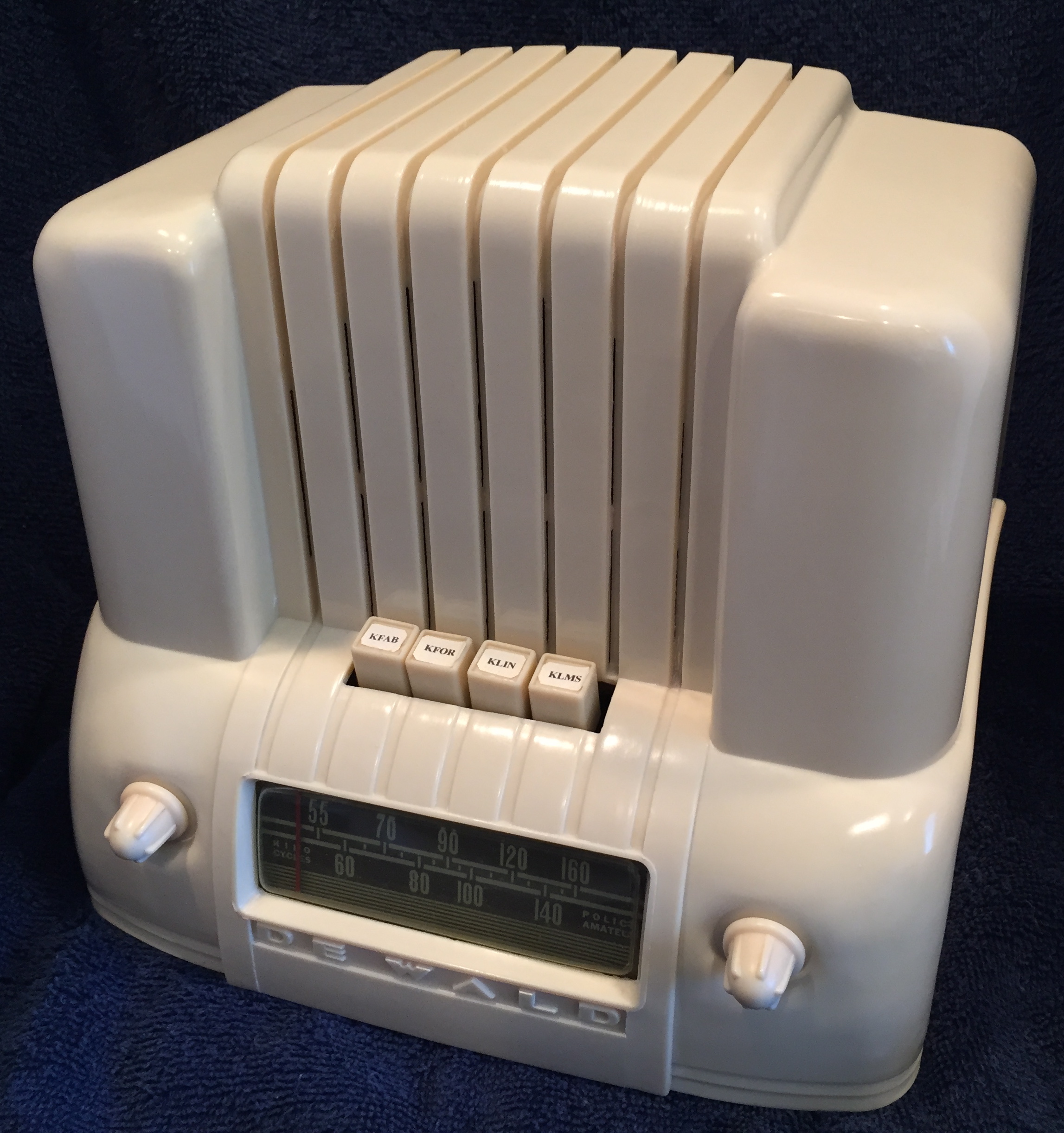
Rarely seen in Plaskon instead of brown Bakelite is the 1938 DeWald model 555 cash register shaped push button radio.  What an original design.
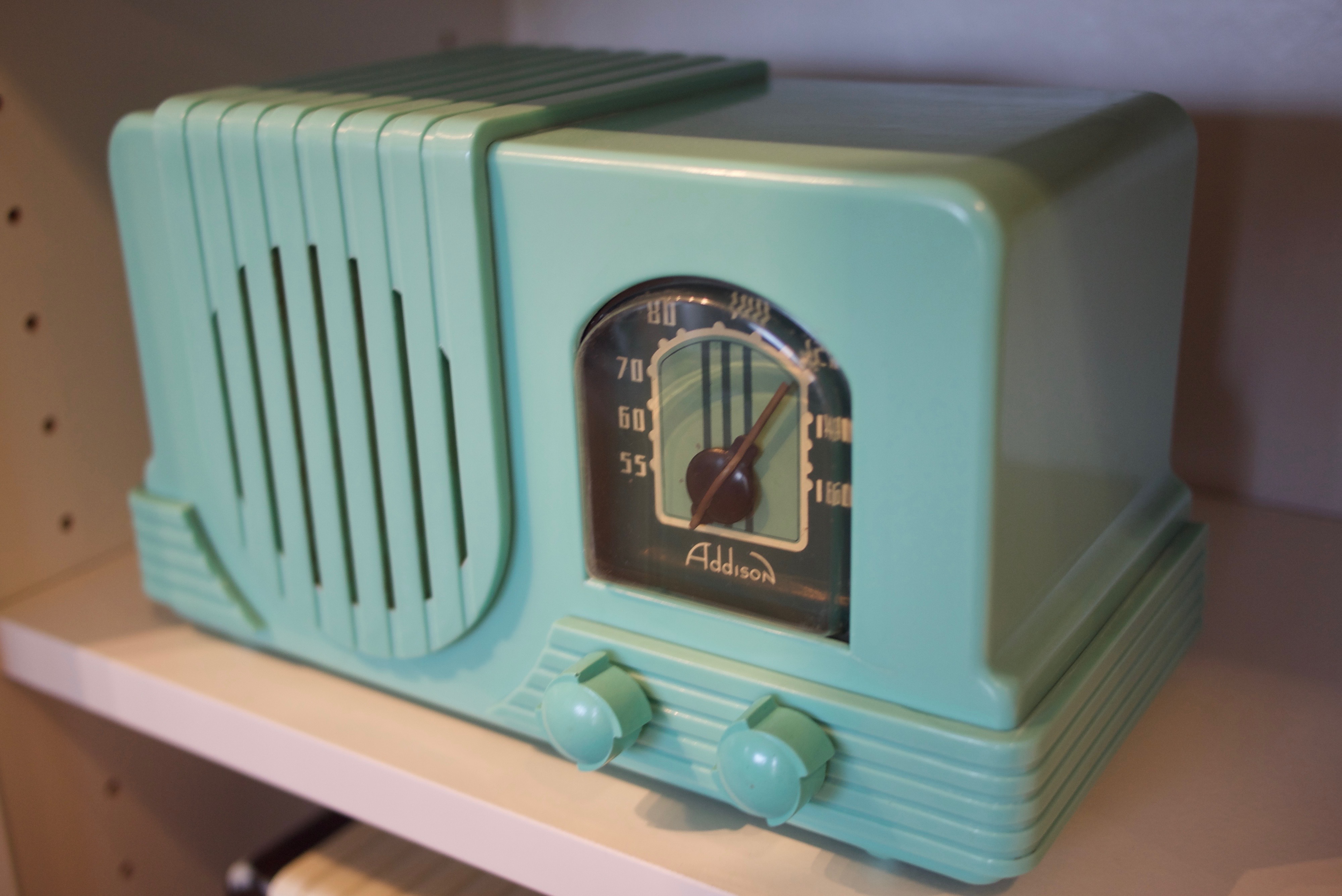
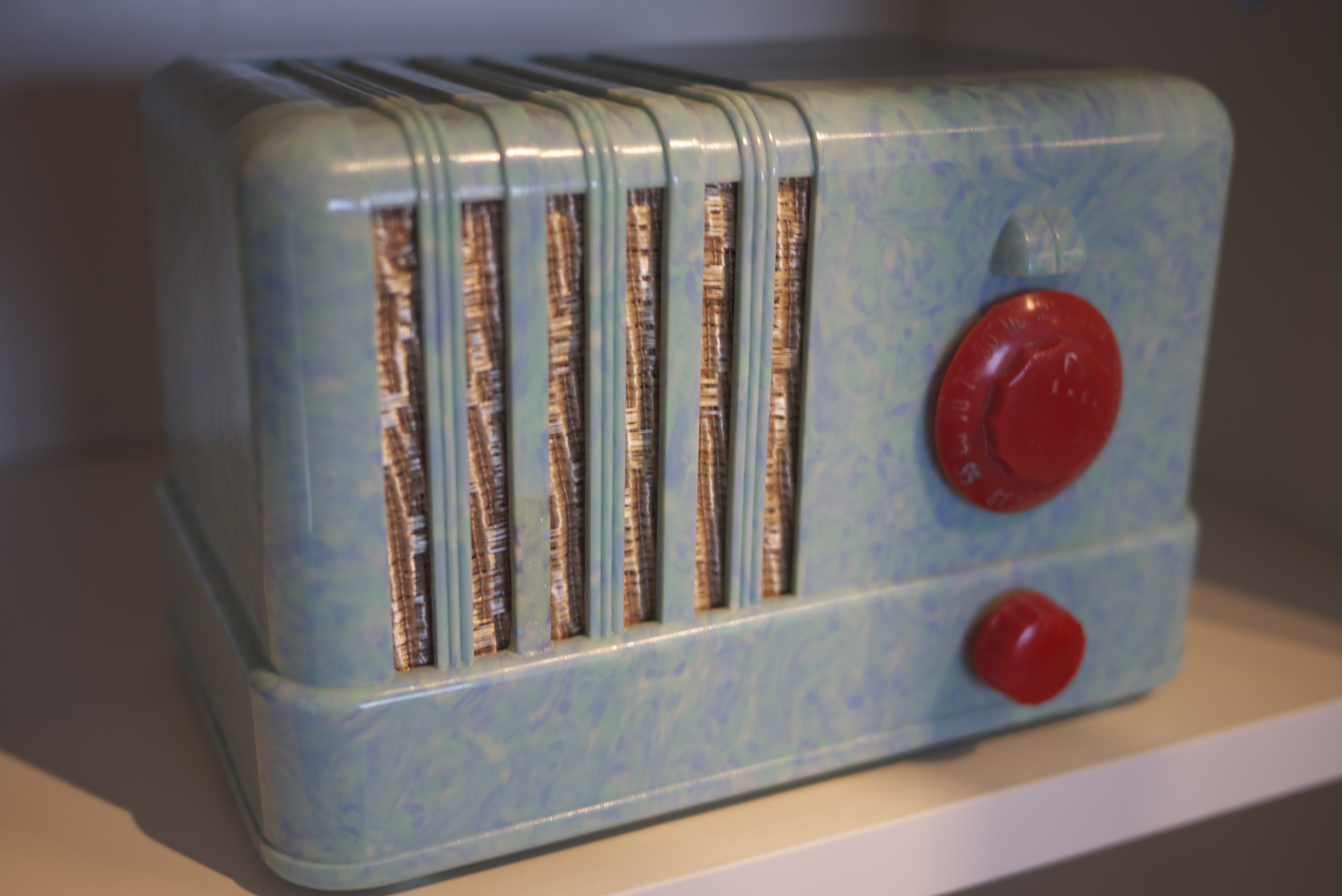
This Addison 2 from 1940 is made of blue/green Plaskon.  Addisons were manufactured in Canada.
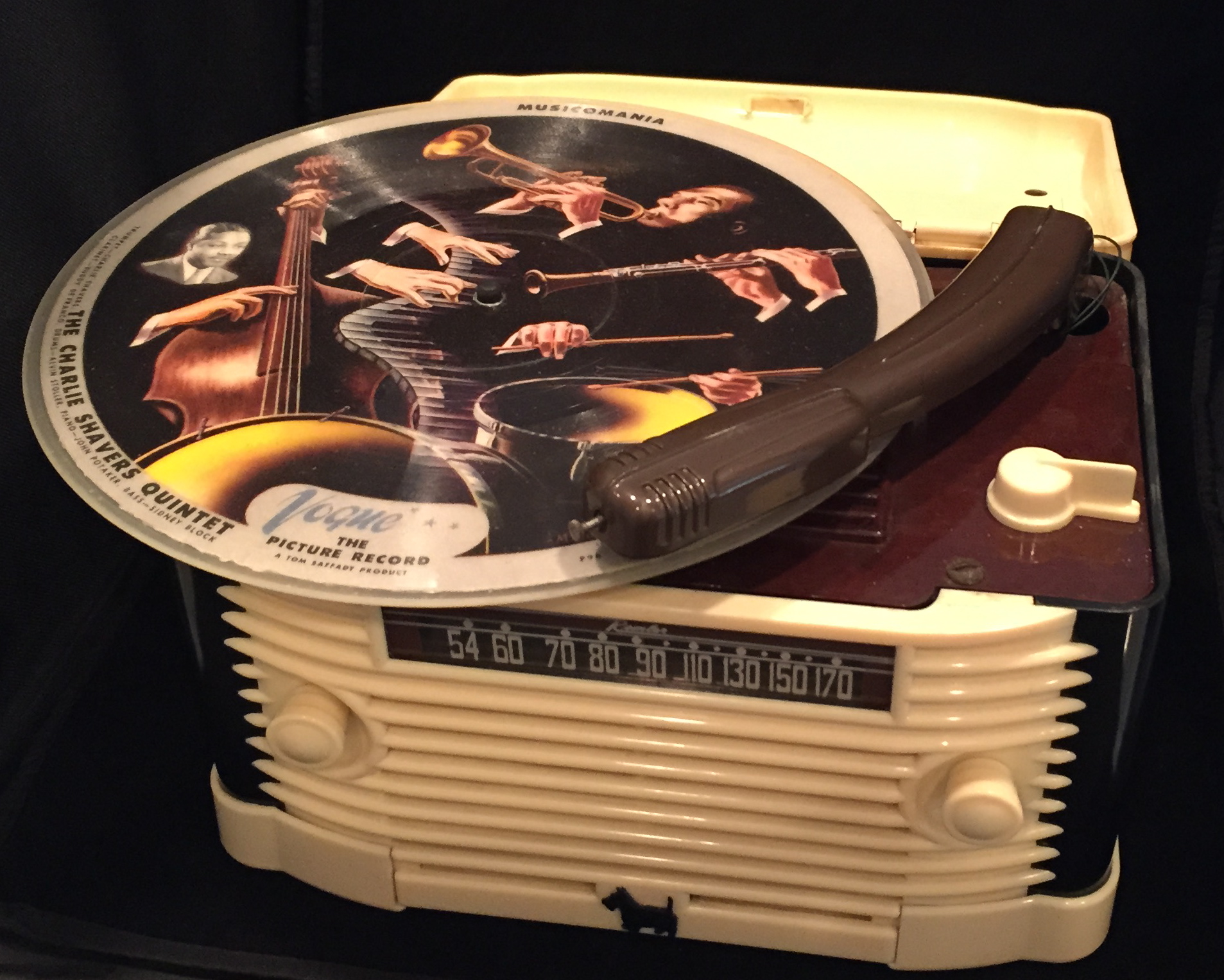
Probably the cleverest and smallest table radio with a record player is this 1947 Remler model 5300.  Much of the radio is ivory Plaskon, but it also incorporates Bakelite.  The lid flips back to allow the 78 rpm records to fit onto a small turntable.
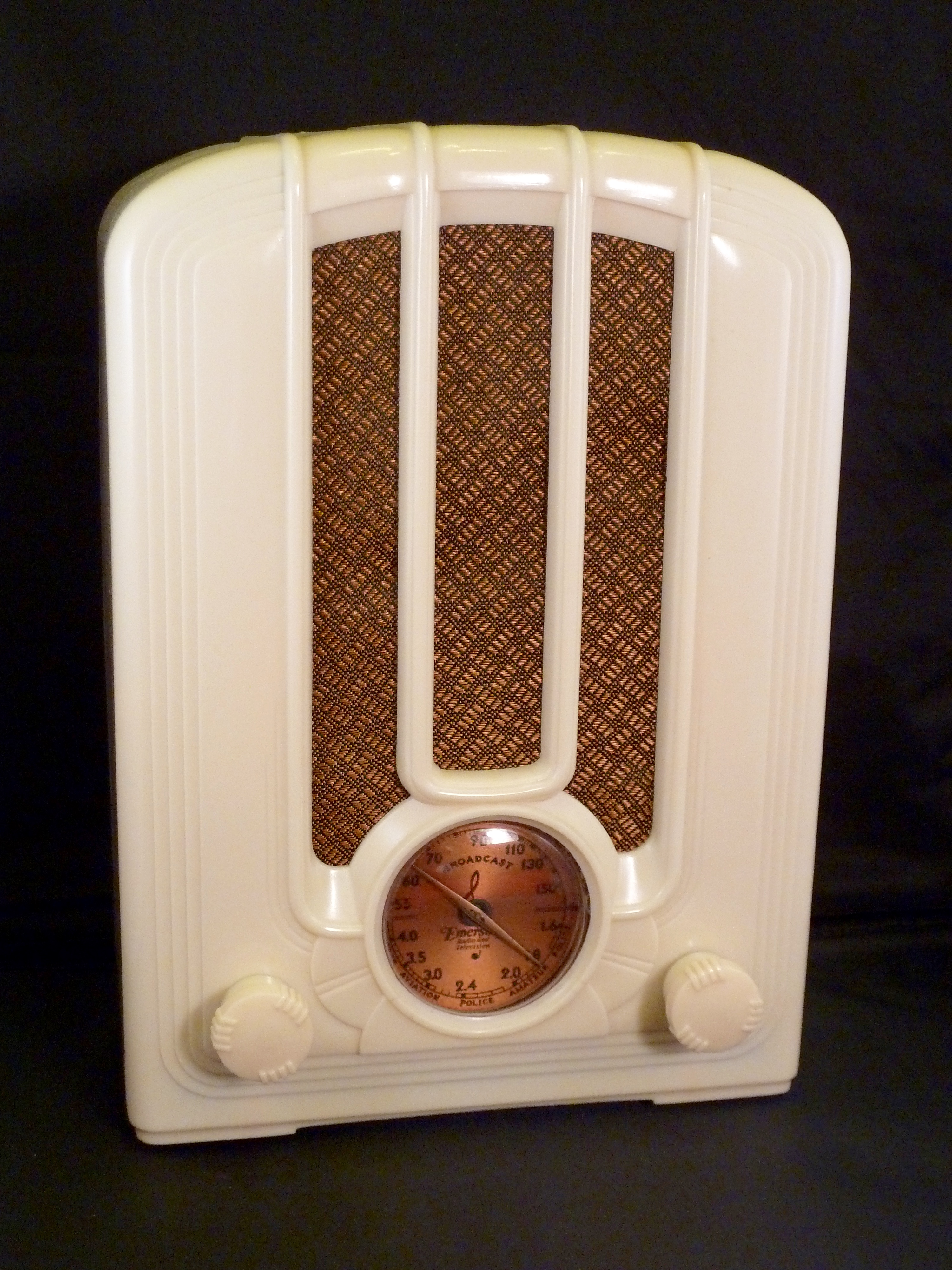
One of the best designed radios ever is this small Emerson tombstone radio, model U5A from 1936.  It’s very detailed molded lines are as Deco as they come.
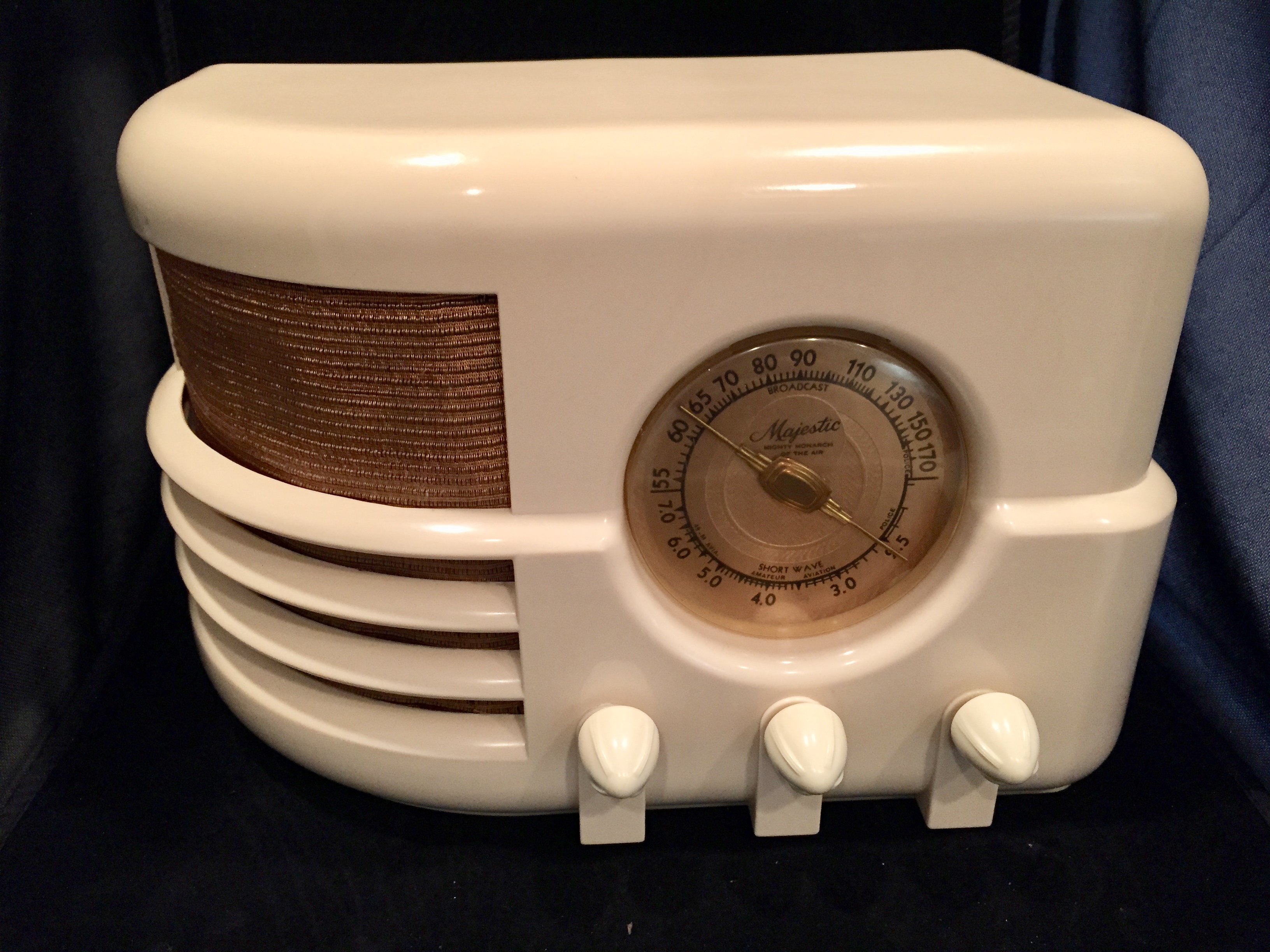
Speaking of Deco, I was given a book about the Deco era, and the only radio they showed in it was this 1937 Majestic model 651 Triple Fin.  Most of these are Bakelite or painted Bakelite, but this one is Plaskon.

Canada was the source for this light blue Gem radio, model 955.  It was manufactured by the Jewel Radio Company in the 1940’s.

This 1939 Detrola model 274 Split Grille is another small radio with an ivory Plaskon case.  The grille and knobs are colored Tenite.
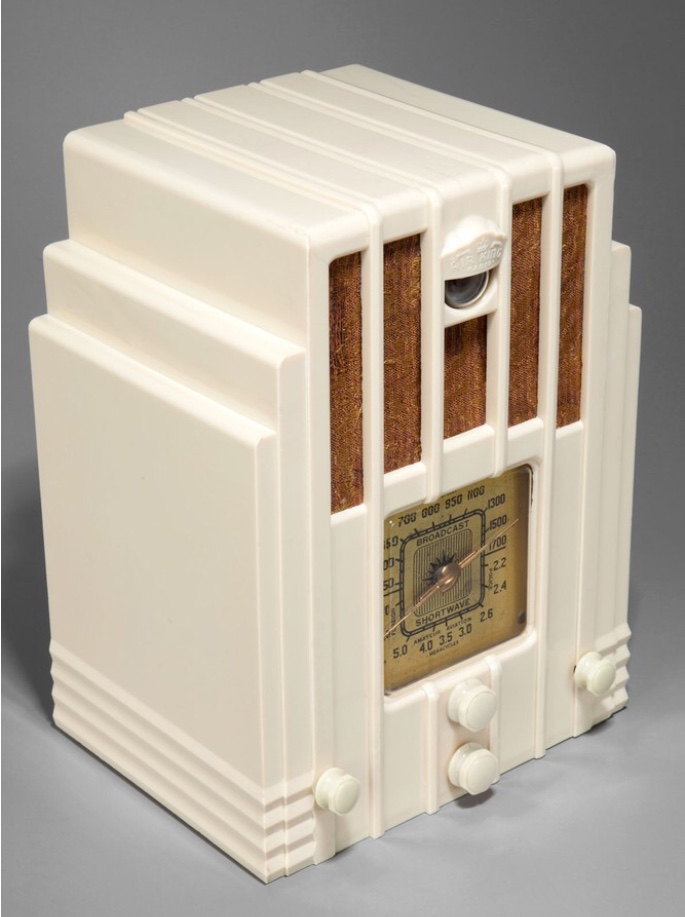
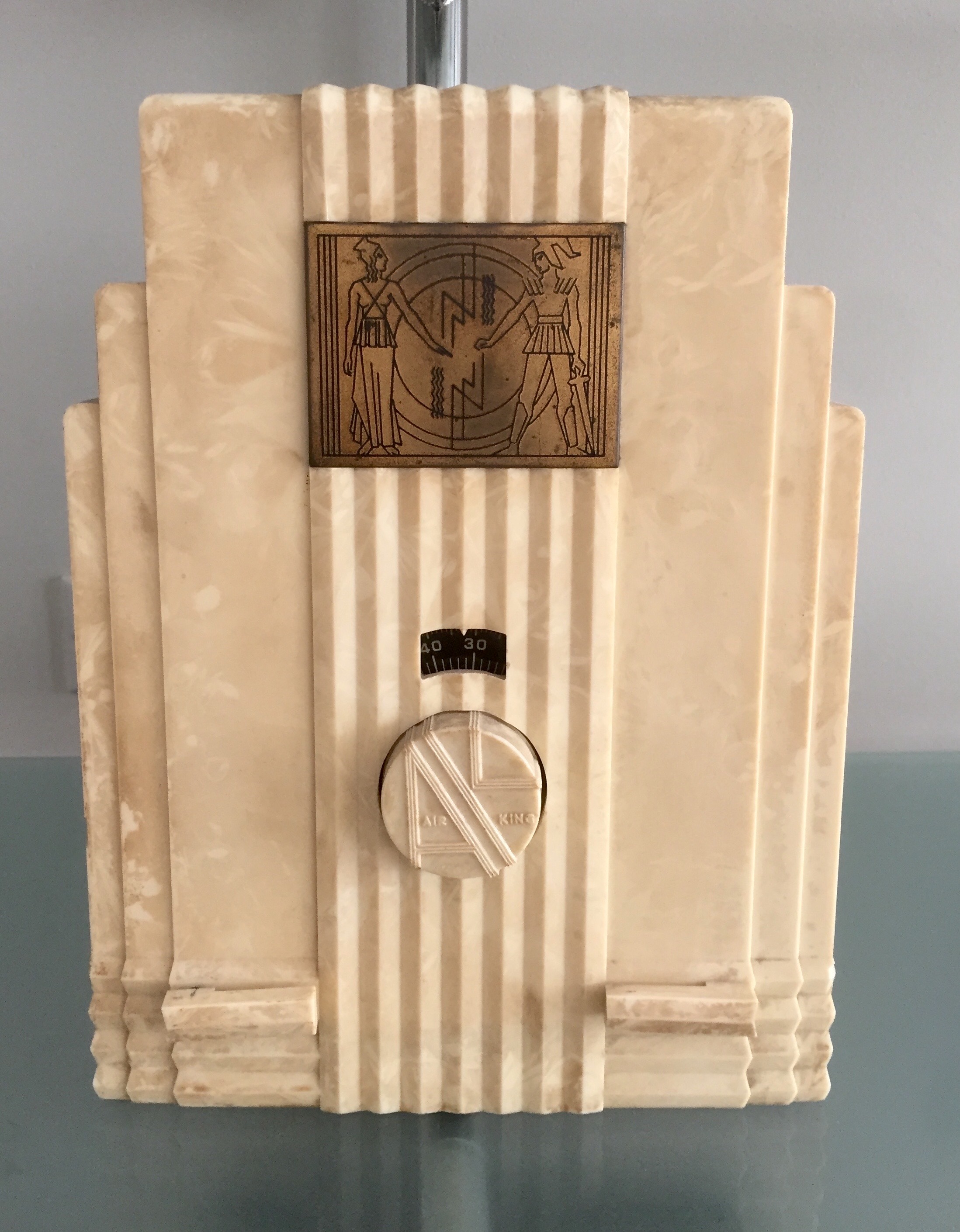
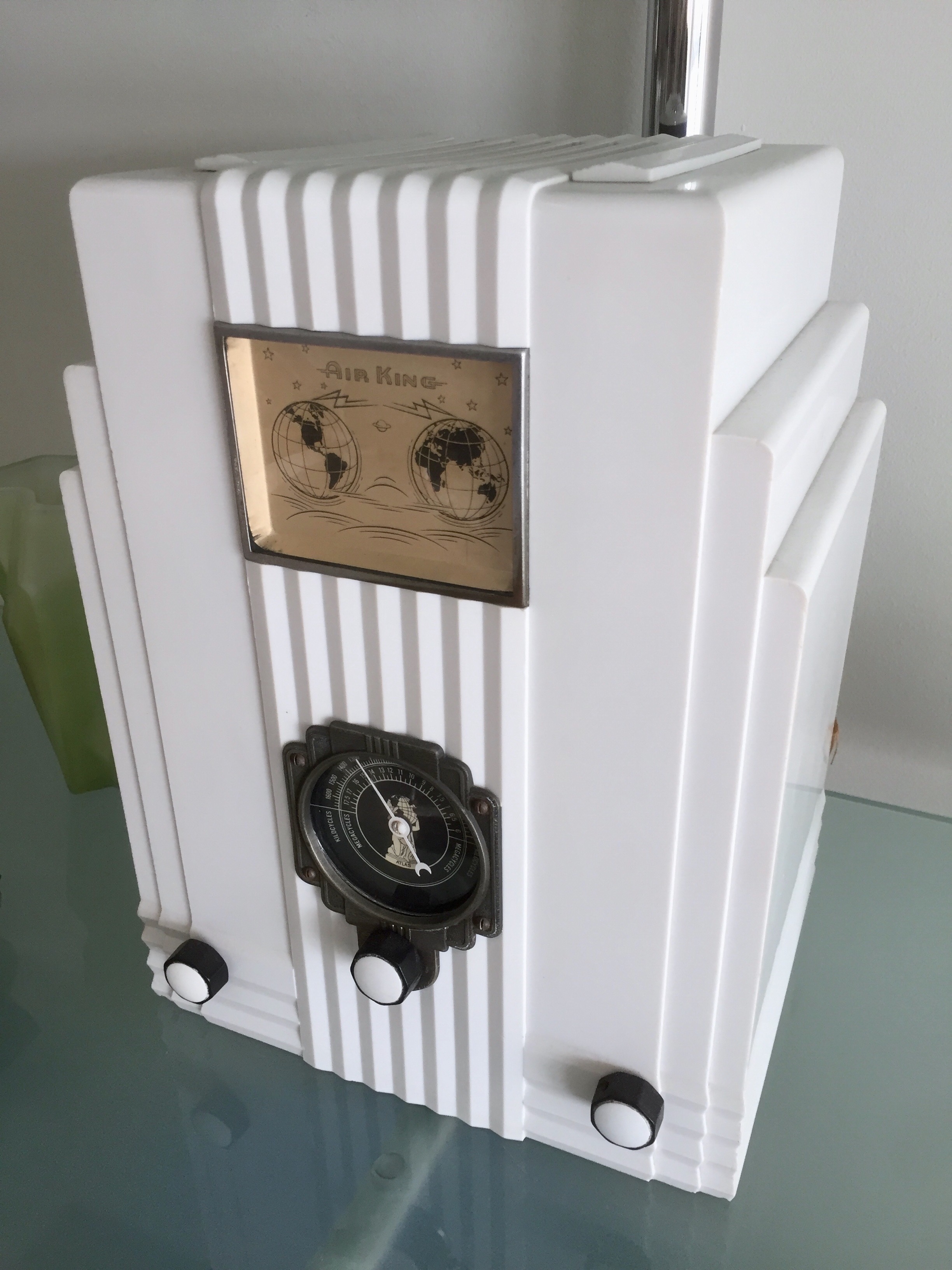
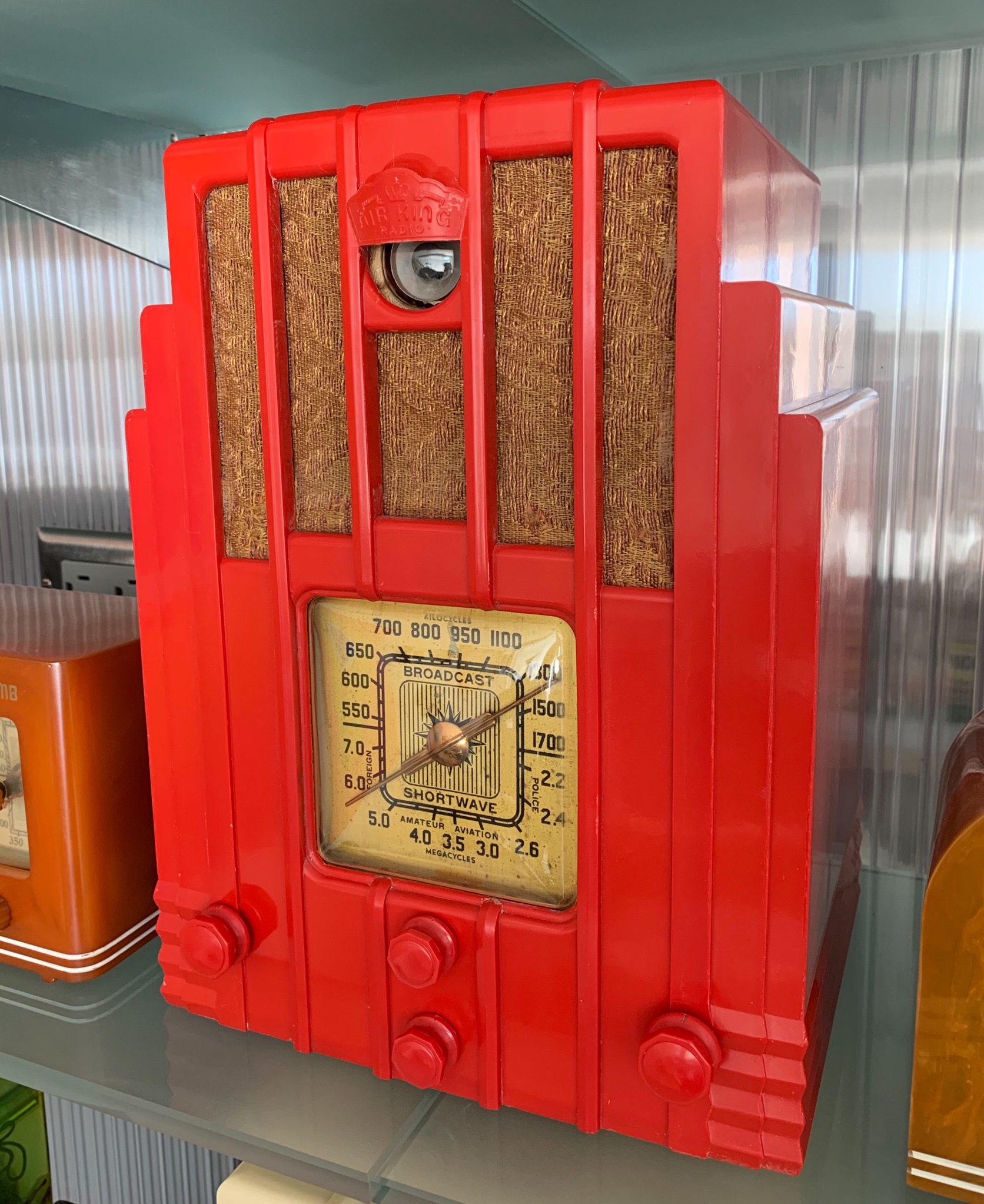
One of the oldest Plaskon designs is the Air King Skyscraper which originated in 1933.  This one, model 770, is from 1937.  It has the speaker opening in the front, instead of on the top like the earlier models.  (Note:  Radio friend G.R. bought this one from me, and took the photo.)

One of the main reasons Plaskon radios can be hard to find is that the cases are pretty thin, making them susceptible to breakage, stress lines and cracks.  Of course their rarity makes them that much more attractive to collectors.
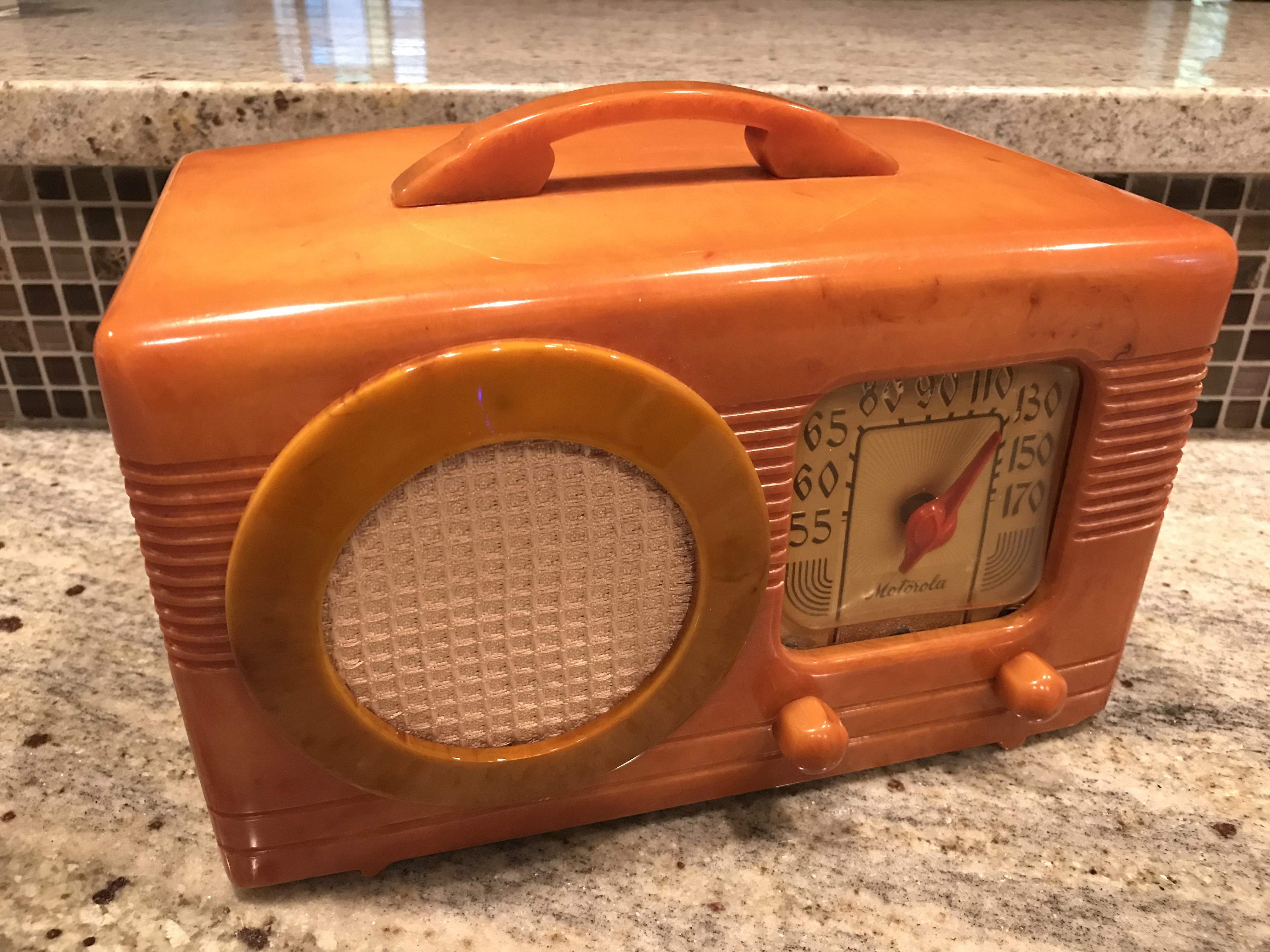
Motorola Circle Grille

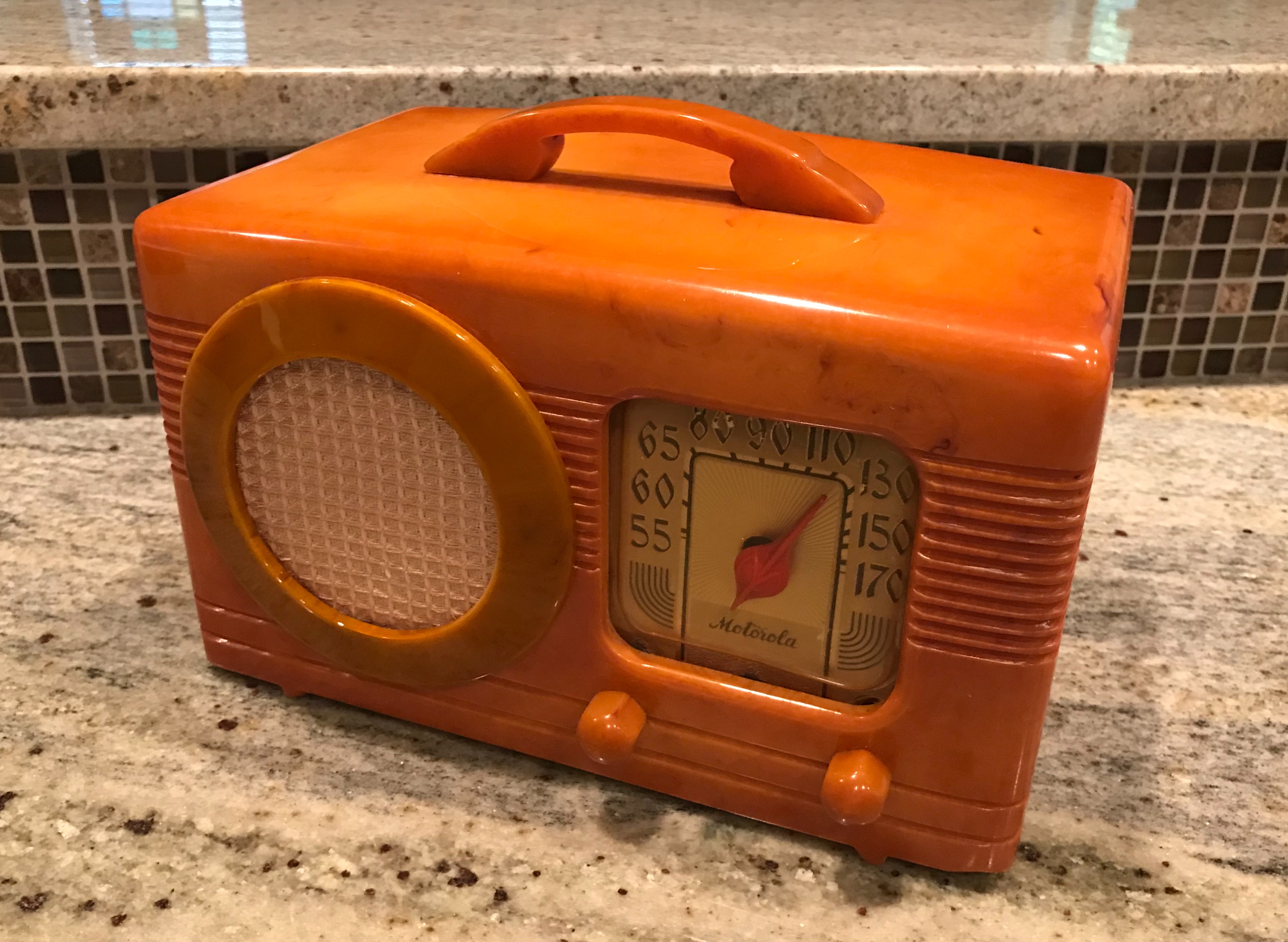
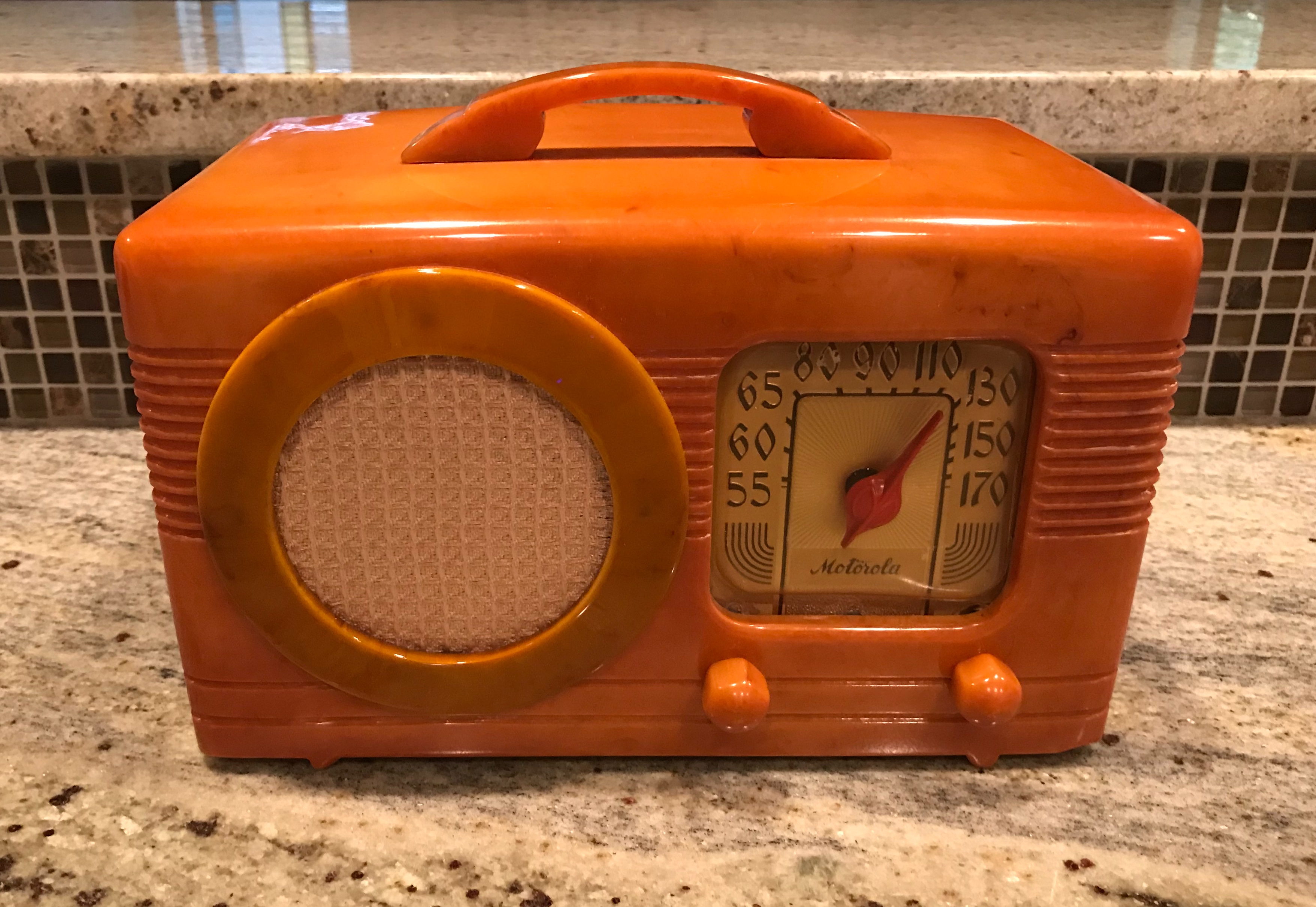
Among the most desirable Catalin radios is the 1940 Motorola 50XC, which is known as the Circle Grille.

It’s a fairly small radio, about 10-inches wide, 6 high, and 5 deep.  This particular radio has a rich butterscotch patina with that deep Catalin shine.  The colors of cases for this model also include red, turquoise, green, & brown tortoise-shell.

In his book “Classic Plastic”, John Sedeli calls the Motorola Circle Grille “One of the most appealing radios”…and says “The cabinet and dial face are both beautifully designed and very Deco.”  The large round speaker bezel and the wrap-around horizontal lines are distinctive features.

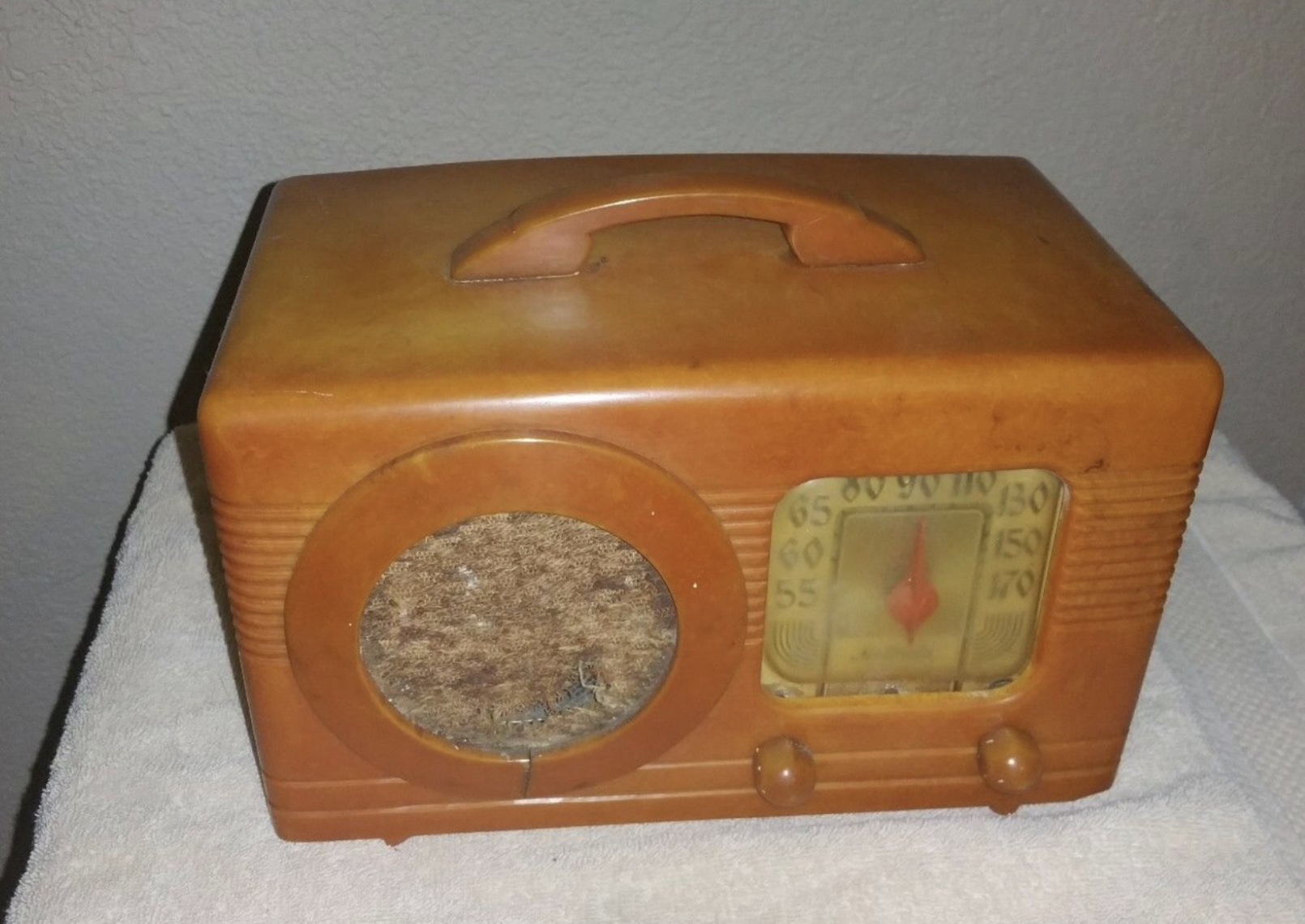
As you can see, this radio was rough-looking when I got it.  The bezel attaches to the case with screws, and someone had over-tightened the bottom screw and split the circle.  Fortunately, that was the only serious problem.  While the speaker bezel was being professionally repaired by Dan Blake, I cleaned the entire radio, and hand-polished the cabinet with Simichrome.  When the bezel was done, I replaced the grille cloth, and also had the electronics completely restored by Northwest Vintage Radio Society member Blake Dietze.

It was a bit of a project, and I needed “a little help from my friends”, but it’s nice to have a Motorola Circle Grille in the collection!

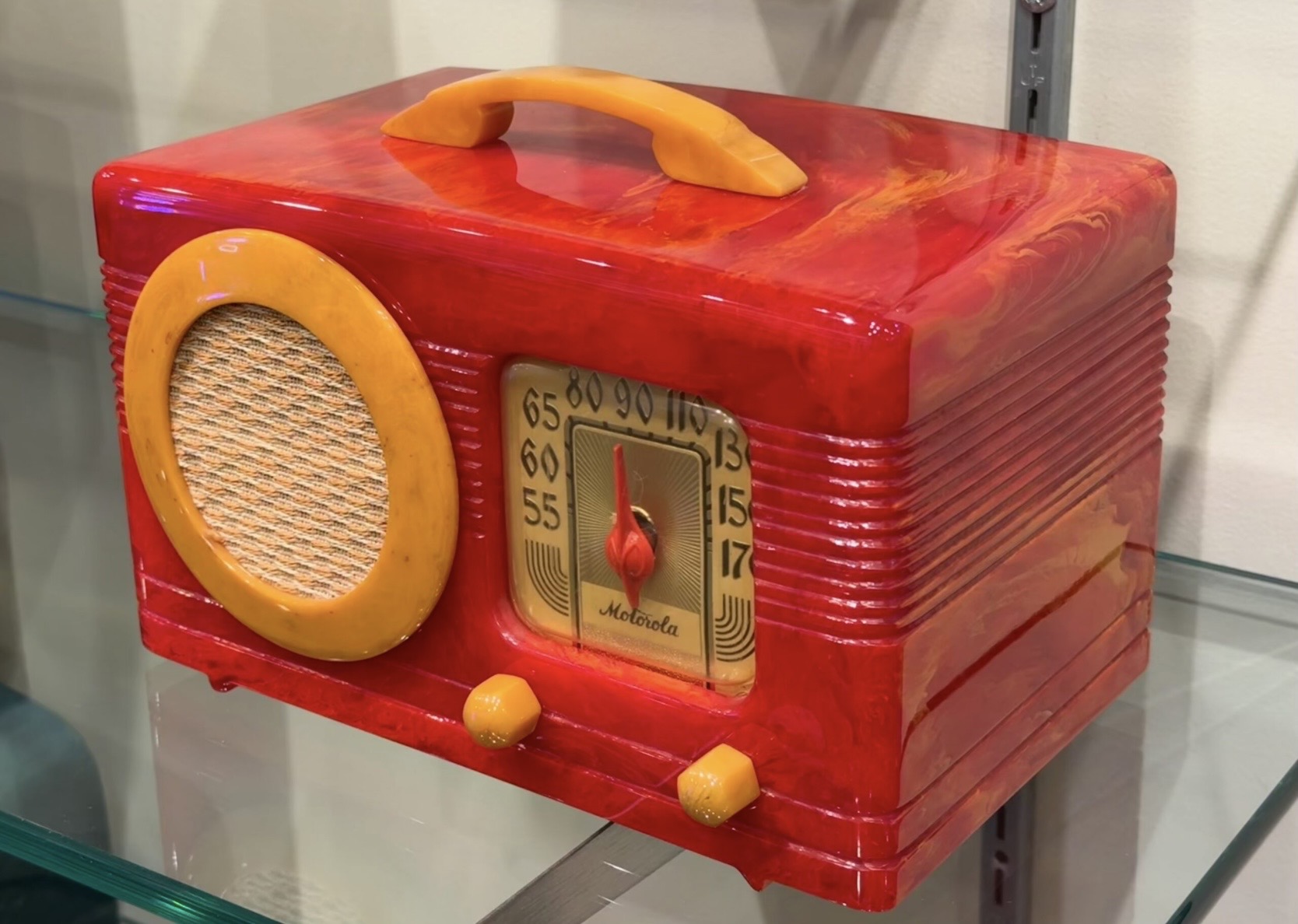
Bonus:  Here’s a truly beautiful version of the Circle Grille from the collection of Hugh & Jane Hunt.

And here’s a whole row of them.

Radio Swap Meet

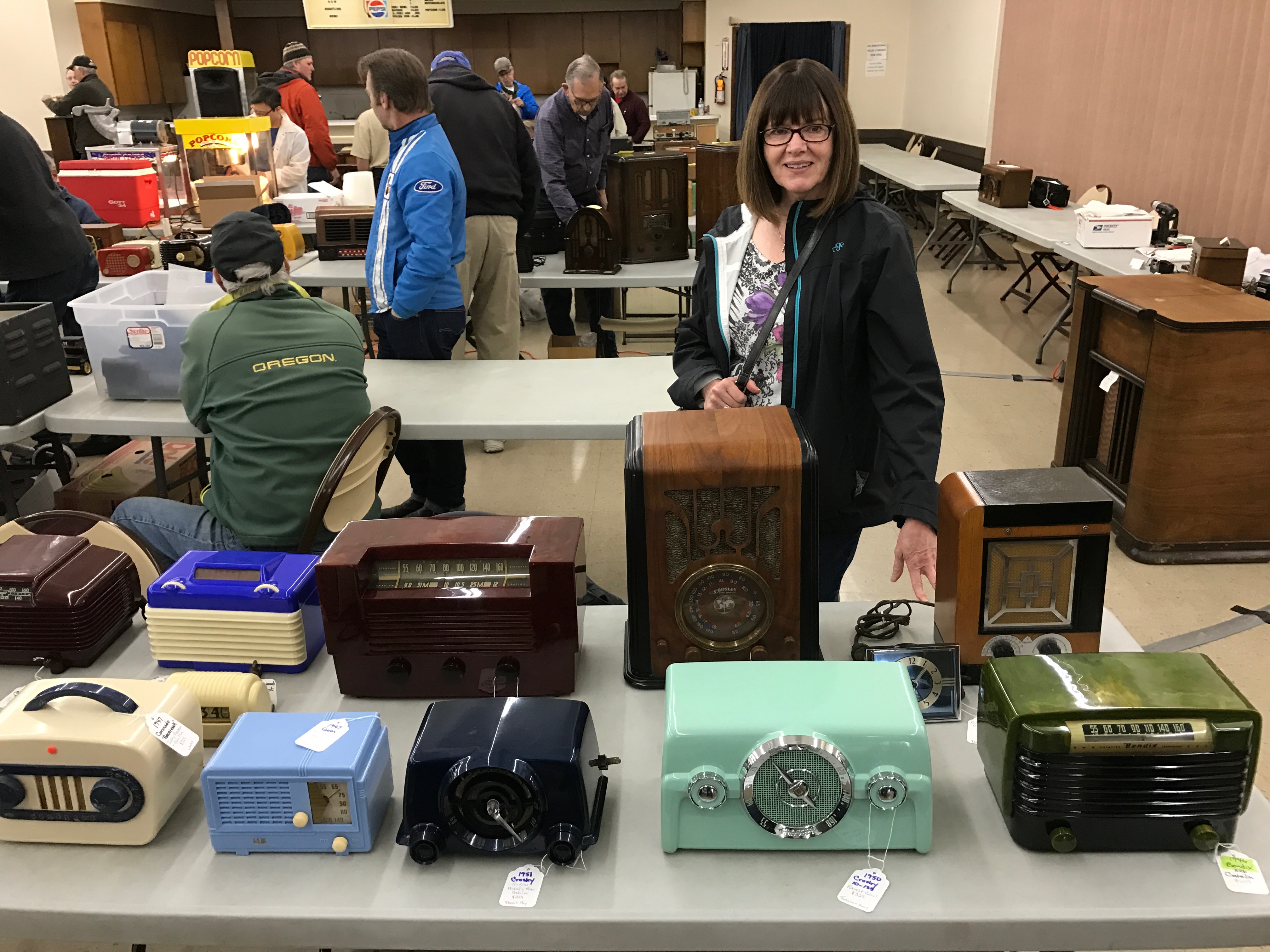
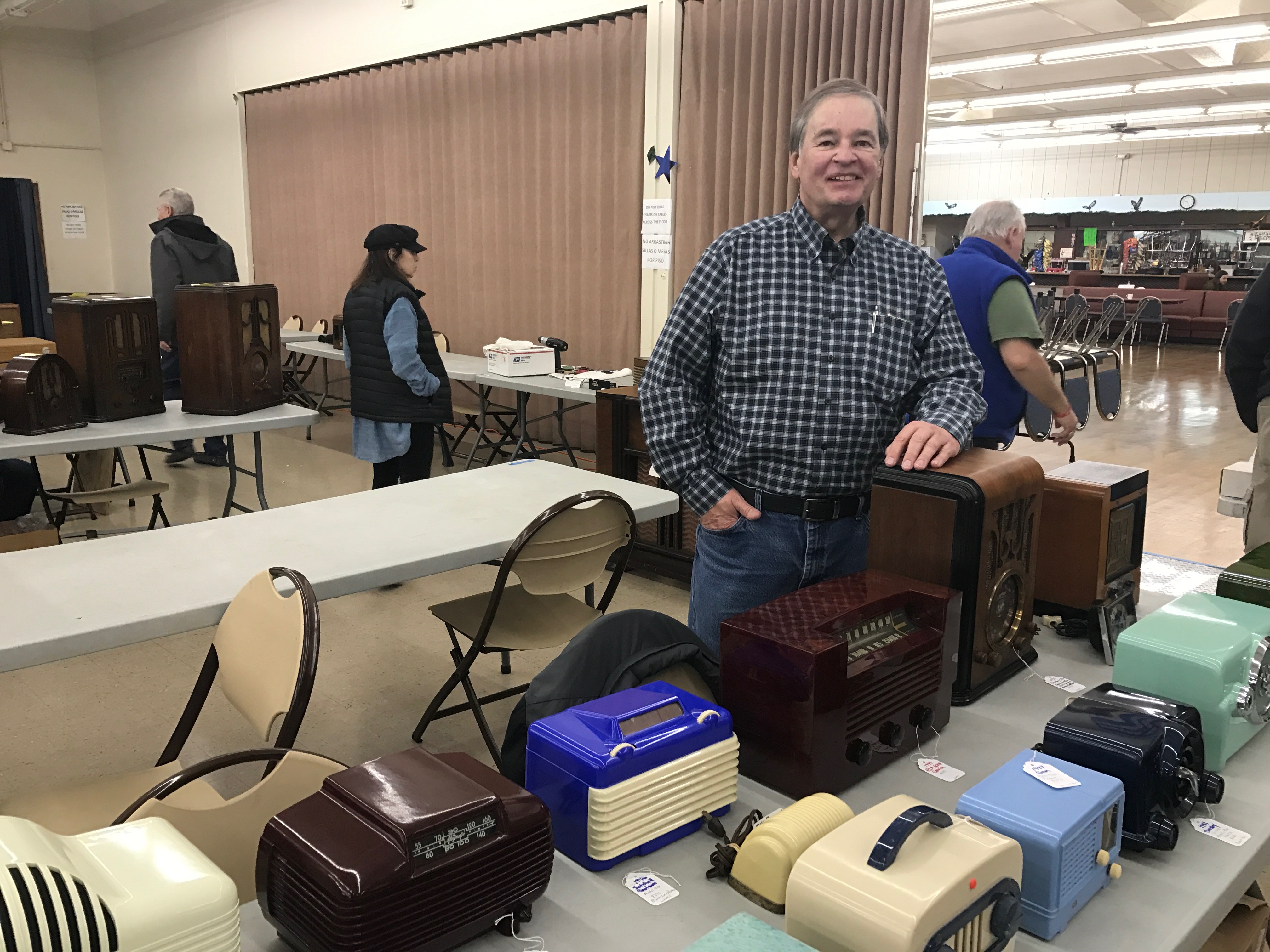
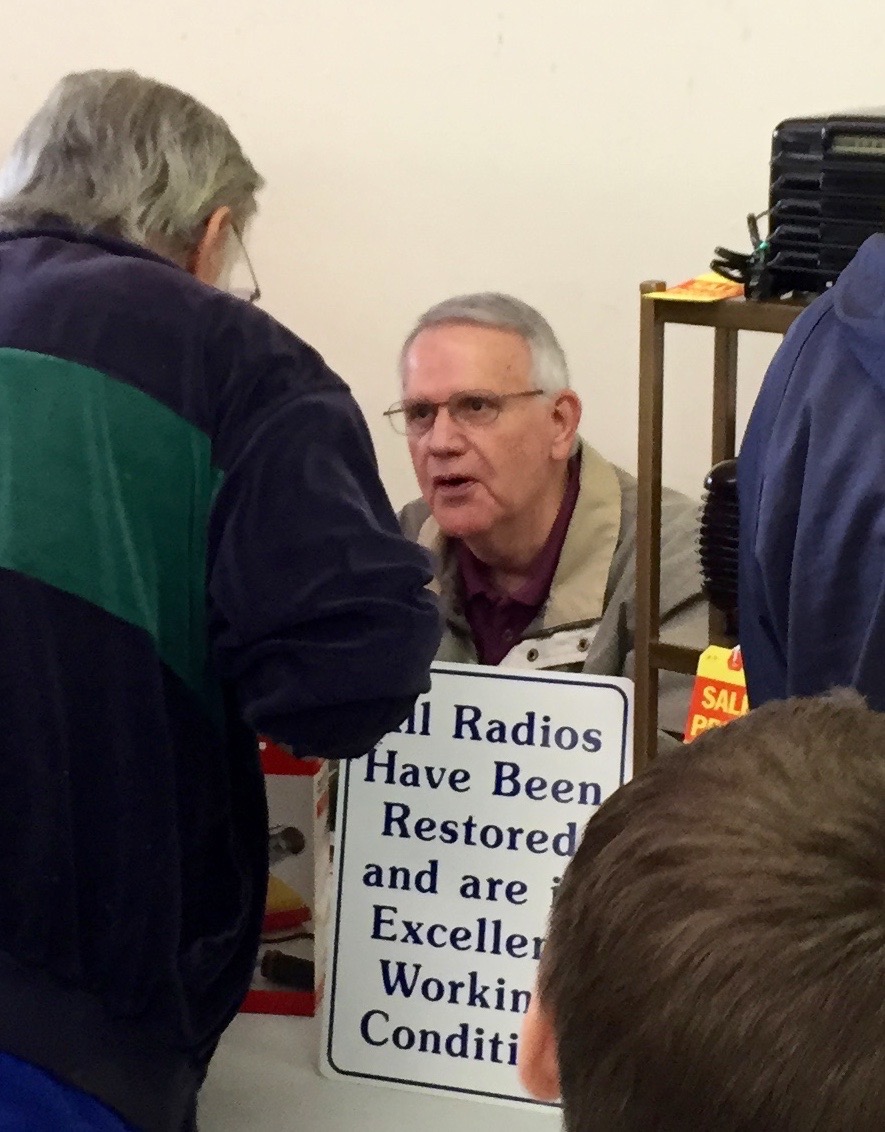
The Northwest Vintage Radio Society had a sale this April in Portland, Oregon.  It was mostly a swap meet with members selling radios and parts to other members, even though the event was open to the public.

My wife, Jeannette, helped bring in all of the radios from our vehicle, and took care of our table while I checked out the other tables.  Unfortunately for me, only a limited number of club members are into collecting Catalin, Bakelite, and other plastic radios.

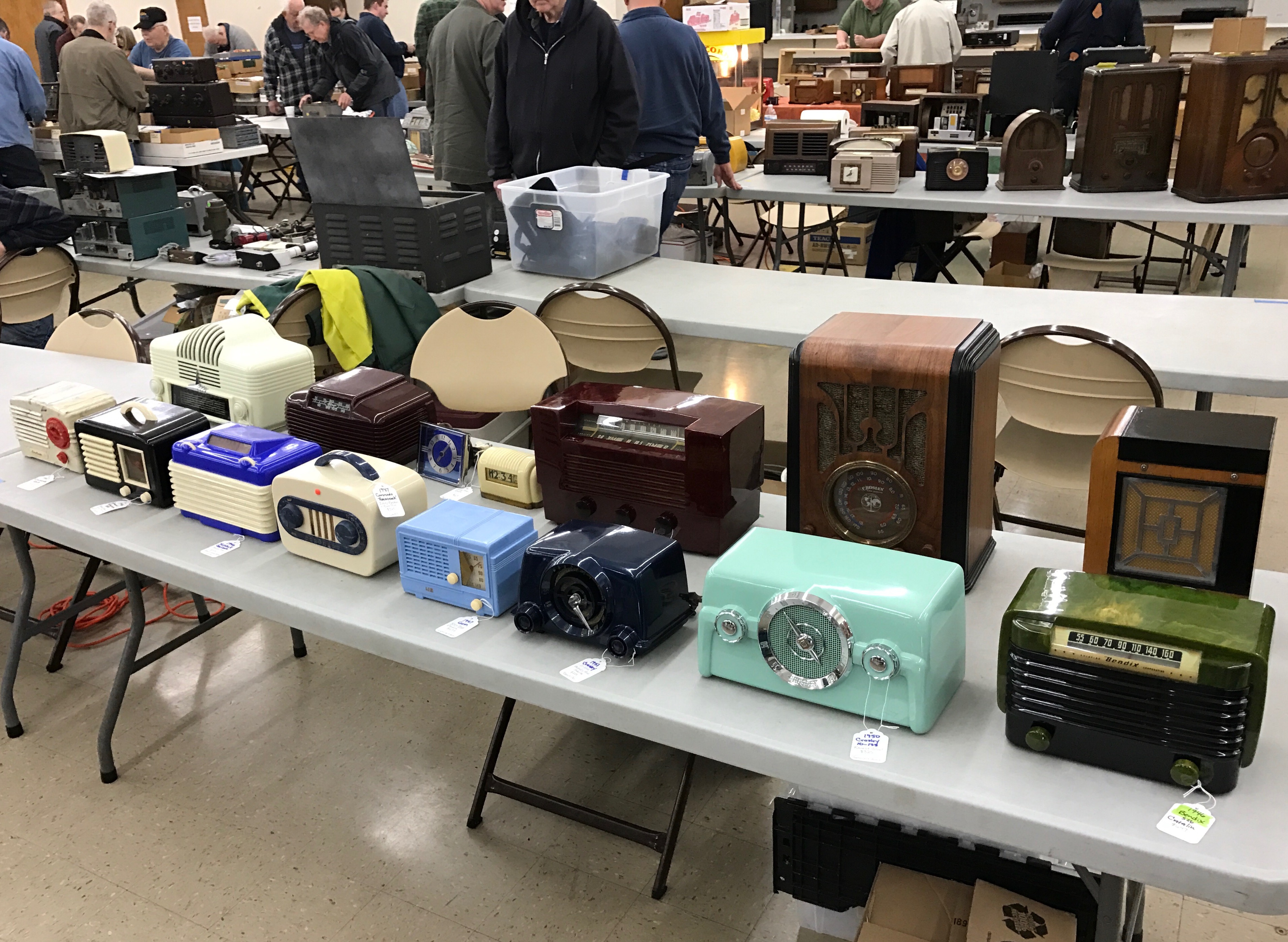
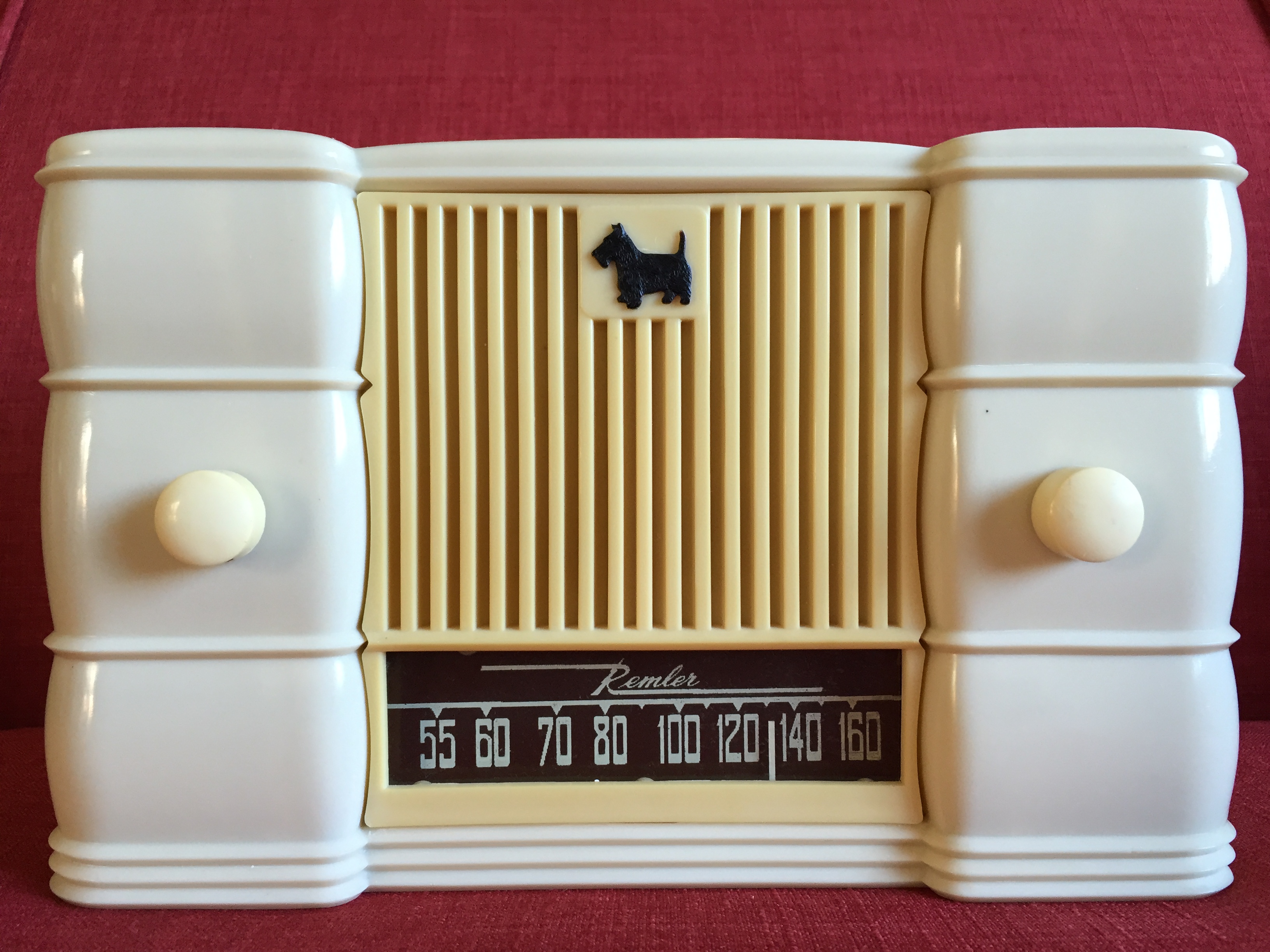
Above are some of the radios we had for sale.  We sold three radios and a Catalin poker chip holder…none of which are pictured…because the photos were taken after the sales.  We’re starting to reduce our collection again, and we were happy to sell three radios, but it looks like we’ll have to use eBay for more sales.  The radios we sold were a black Bakelite Philco TP7, an ivory Plaskon Remler Scottie, and a Canadian blue Beetle Plastic GE C400…all shown below.

Emerson Tombstones…Catalin, Plaskon, Wood

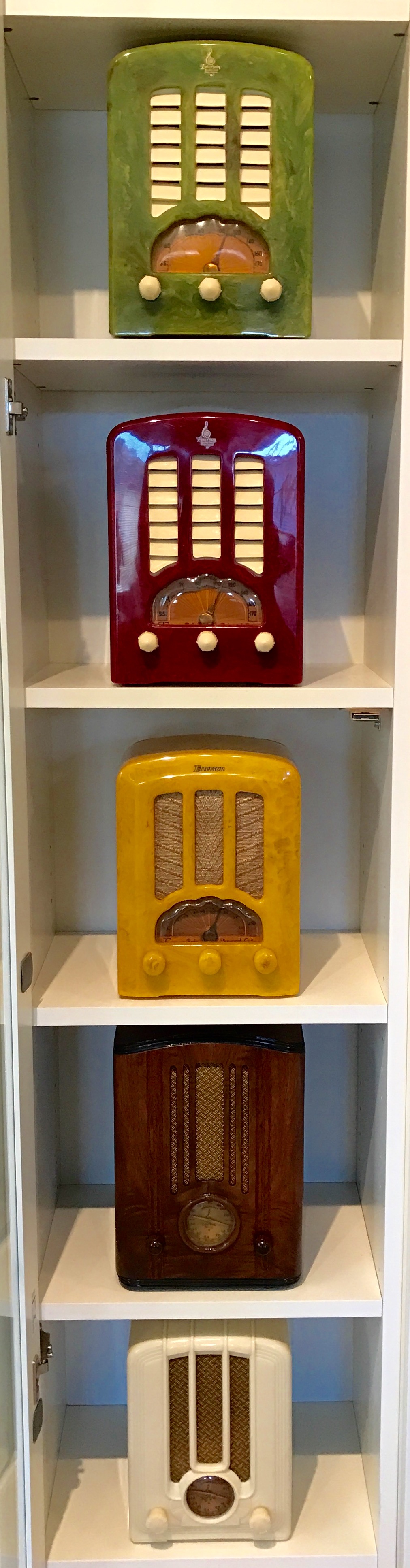
Emerson Tombstones from 1936 to 1938:

img_7355

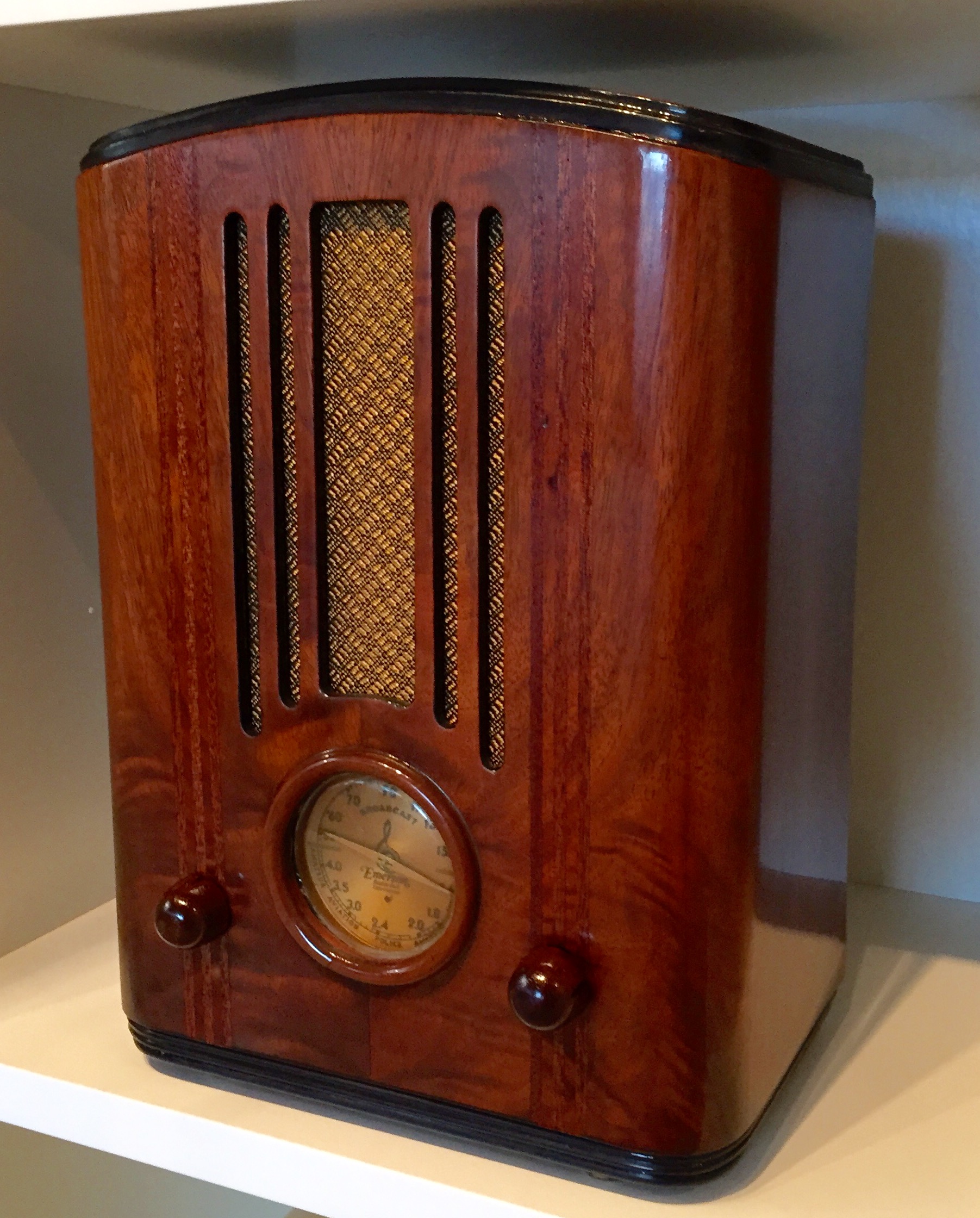
Emerson Tombstones are among the coolest table radios ever designed.  Sometimes they’re called “mini-Tombstones”, because they’re only about 10-inches high and 7-inches wide.  That’s definitely “mini” compared with the large wooden Tombstones of the 1930’s.  The oldest of these radios are the Wooden 110 and the ivory Plaskon U5A, both from 1936.img_2766This version features some beautifully grained & inlaid wood, along with acorn knobs.  It’s slightly larger than the Plaskon version, even though they use the same chassis.

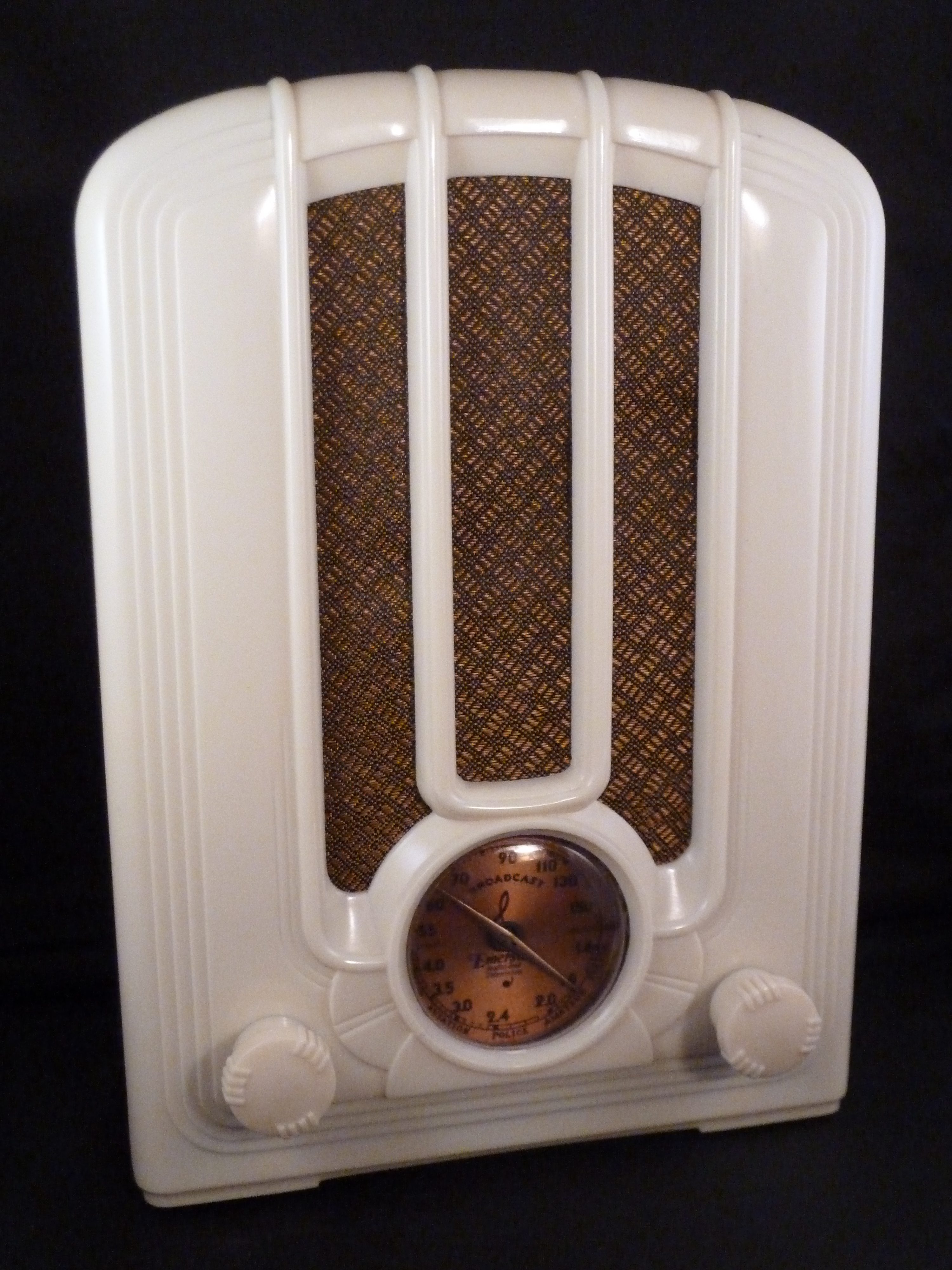
p1040438The 1936 ivory Plaskon Emerson is the most Deco version, with a lot of great design touches that are simply too intricate for Catalin or wood.

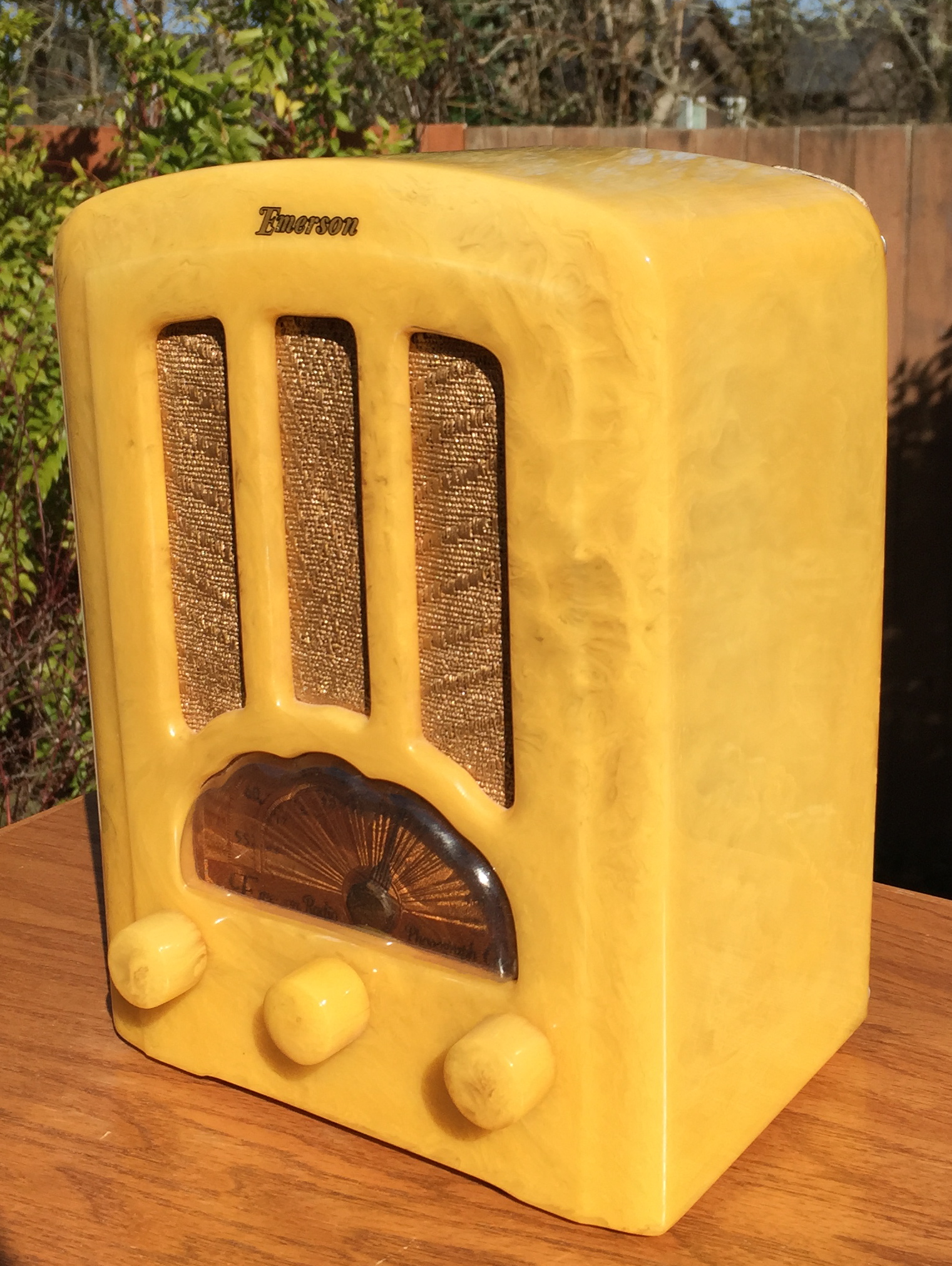
It was a year later, 1937, for the first Catalin version:img_2153The 1937 Model AU-190 has a sculptured front, features a distinctive grille cloth, a sunburst dial, and chunky Catalin knobs.  Another year later, there were some major style changes.

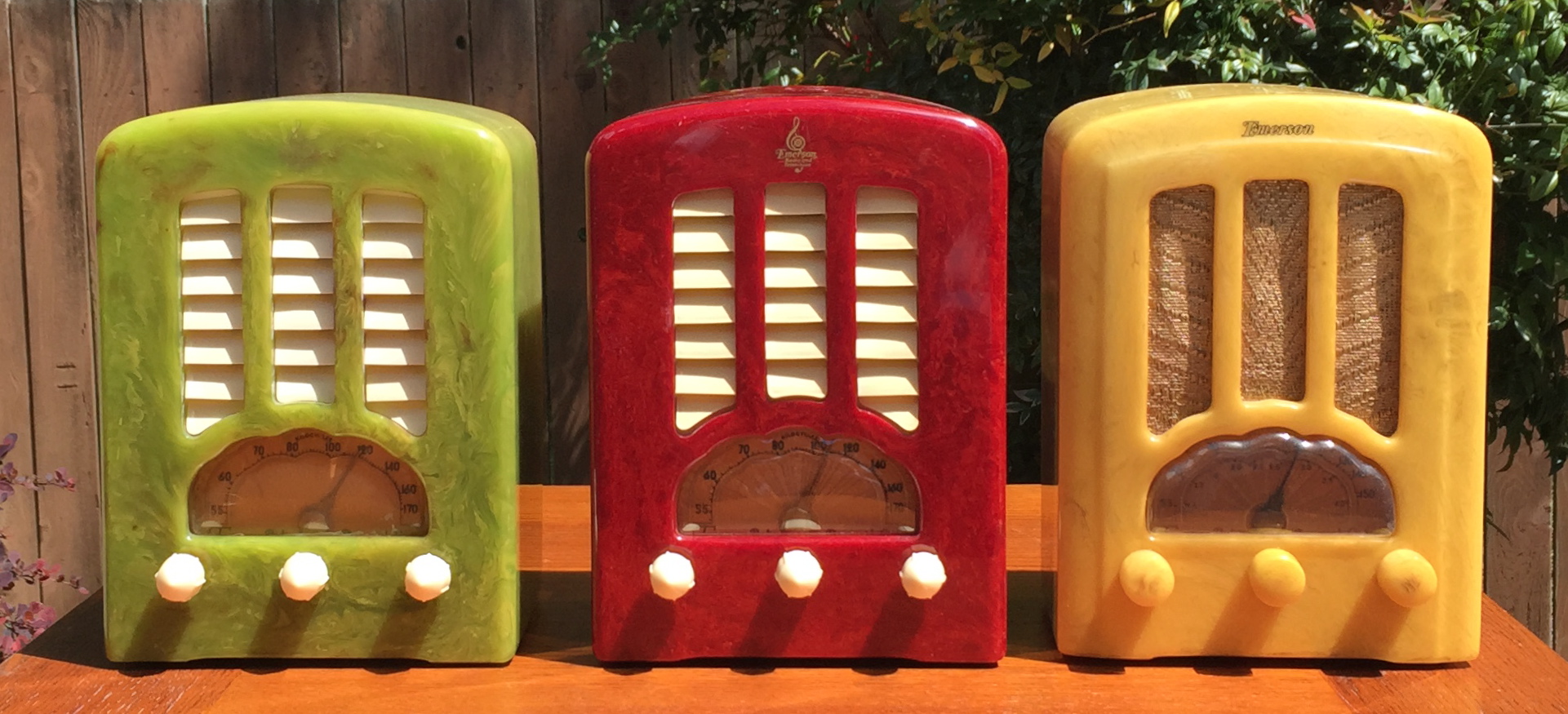
img_3473The 1938 Catalin Model BT-245 case is similar, but it drops the sculptured front, and most dramatically it has a contrasting off-white louvered grille, and matching knobs.  In his book “Classic Plastic”, about Catalin Radios, John Sideli says “This is probably one of the most successful design updates that you could ever find.”  He also says the beautiful colors were accented by the contrasting grilles and knobs.  I’m also partial to the contrasting colors of the 1938 model, with the above red being my favorite version.  However, many collectors prefer the 1937 model.  My guess is because the plastic is all Catalin, and those Catalin knobs are definitely more impressive than the ivory plastic ones.

IMG_3380Catalin shouldn’t be left in the UV rays for long!

Lafayette BB-22…how rare?

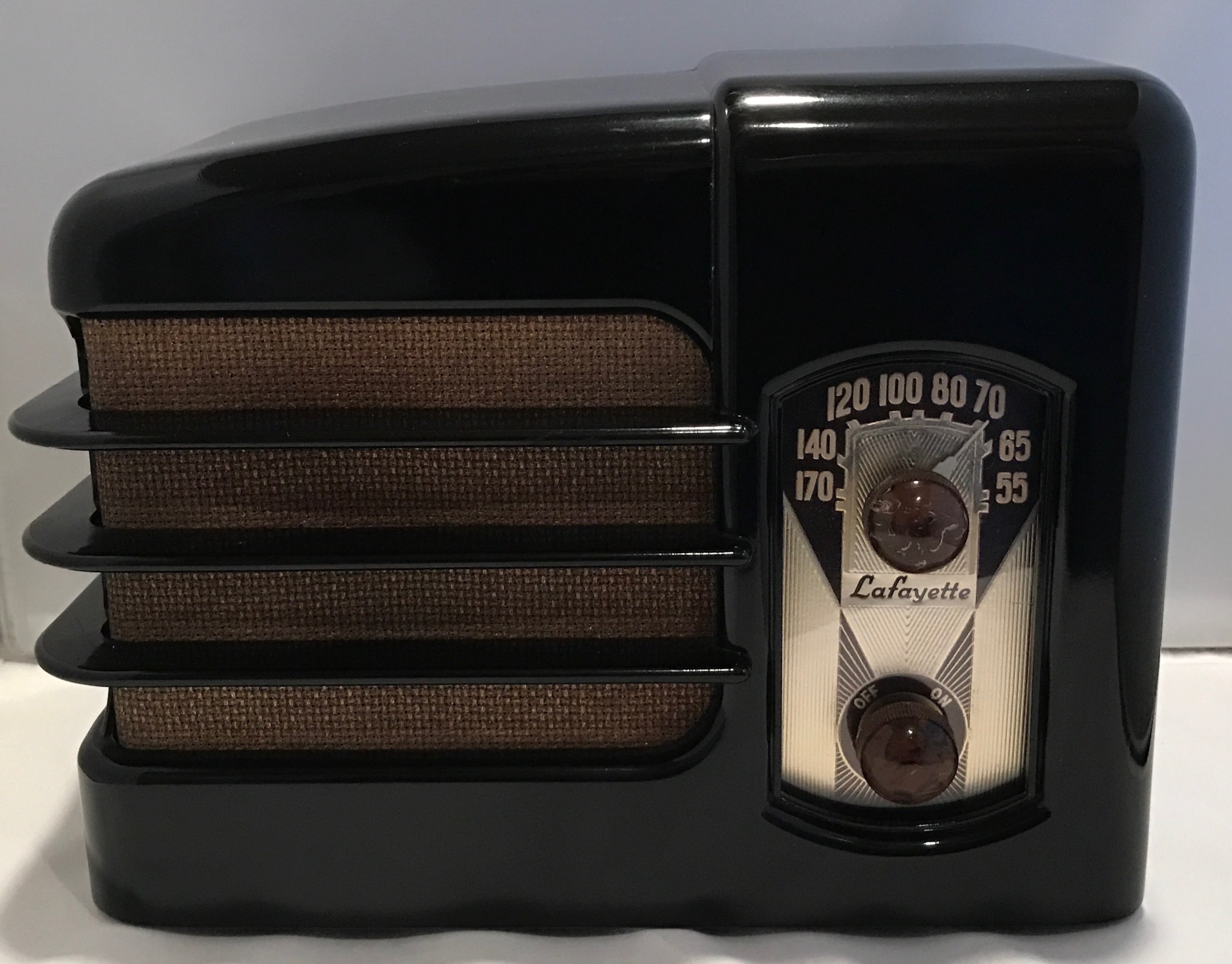
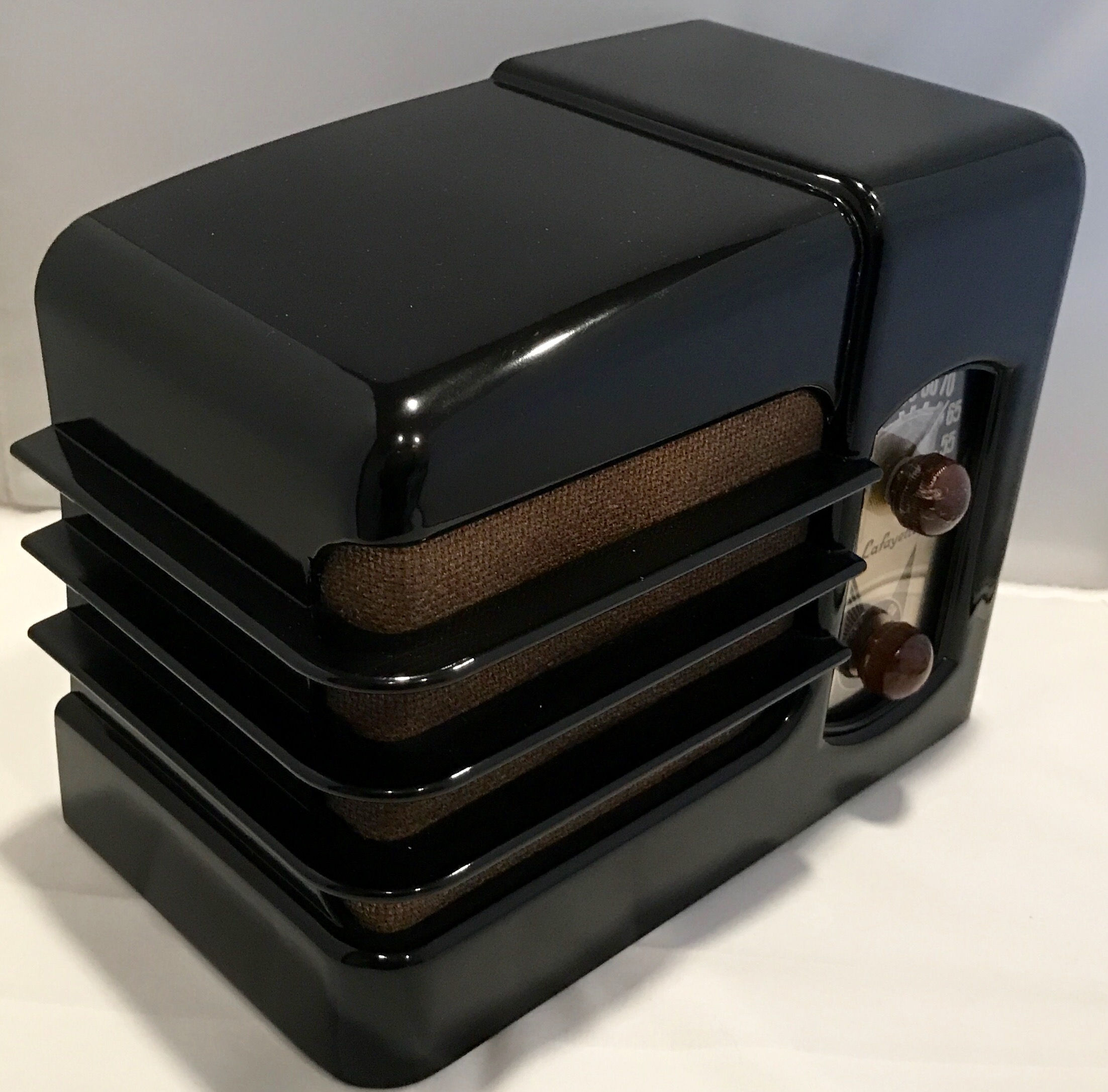
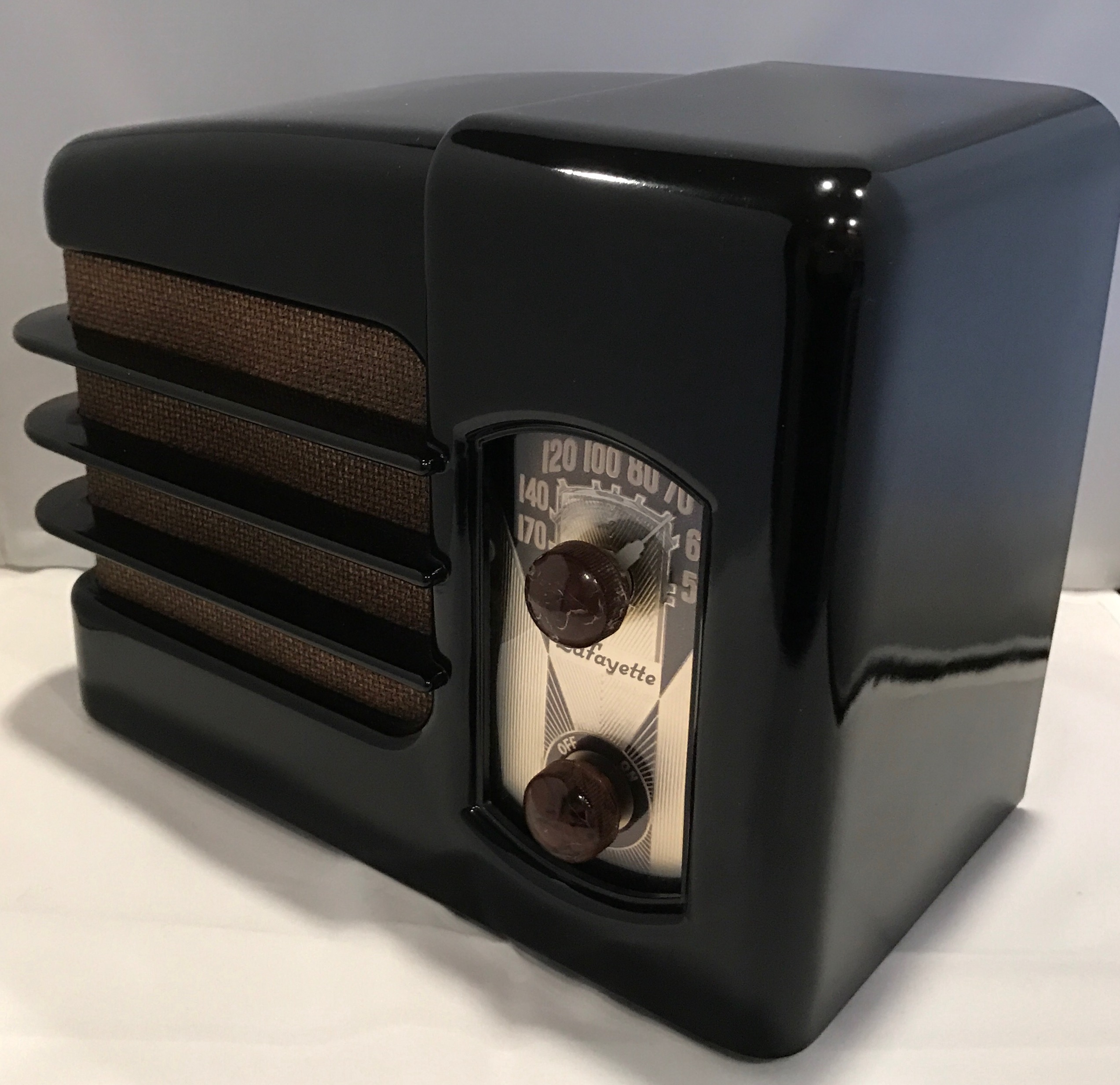
Normally when you go to Google Image and put in the name of a radio, you get lots of photos.  When I Googled the Lafayette BB-22, I got one photo and one graphic from an old price guide.  The photo was from the Radio Museum, and that radio had the wrong knobs.  Here’s the Lafayette I recently acquired:img_7085

It was made in 1940, and has the bold streamlined Deco look of the era.

img_7099

The one from the Radio Museum is black, as is this one.  This particular radio was saved from extinction by someone who did a great job of repairing some cracks (which can be seen only from the inside) and doing such a professional paint job that at first I thought it was black Bakelite.  It’s only the second repainted radio in my collection, and I’m more than happy to add this distinctive design.

img_7091

img_7121

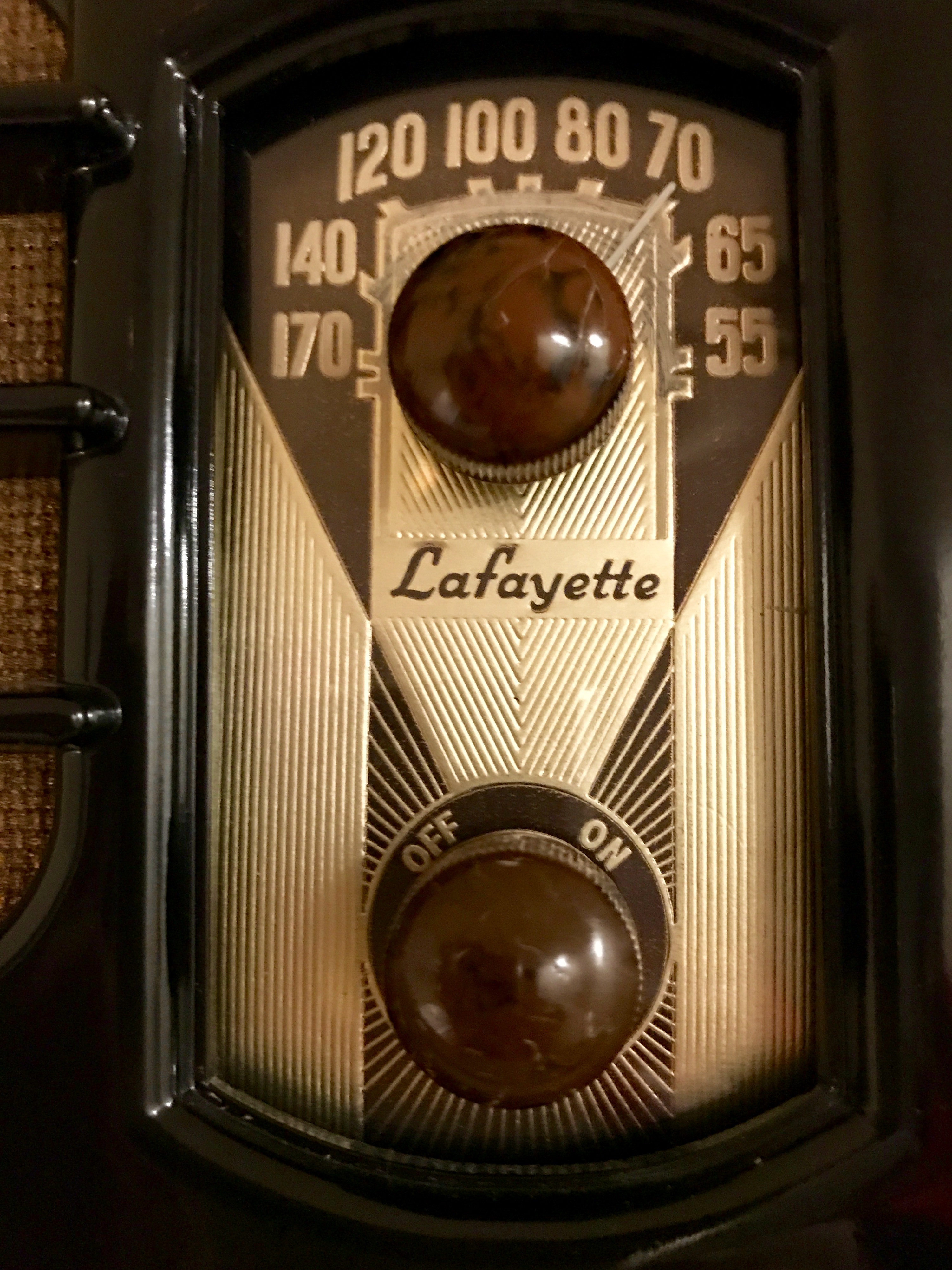
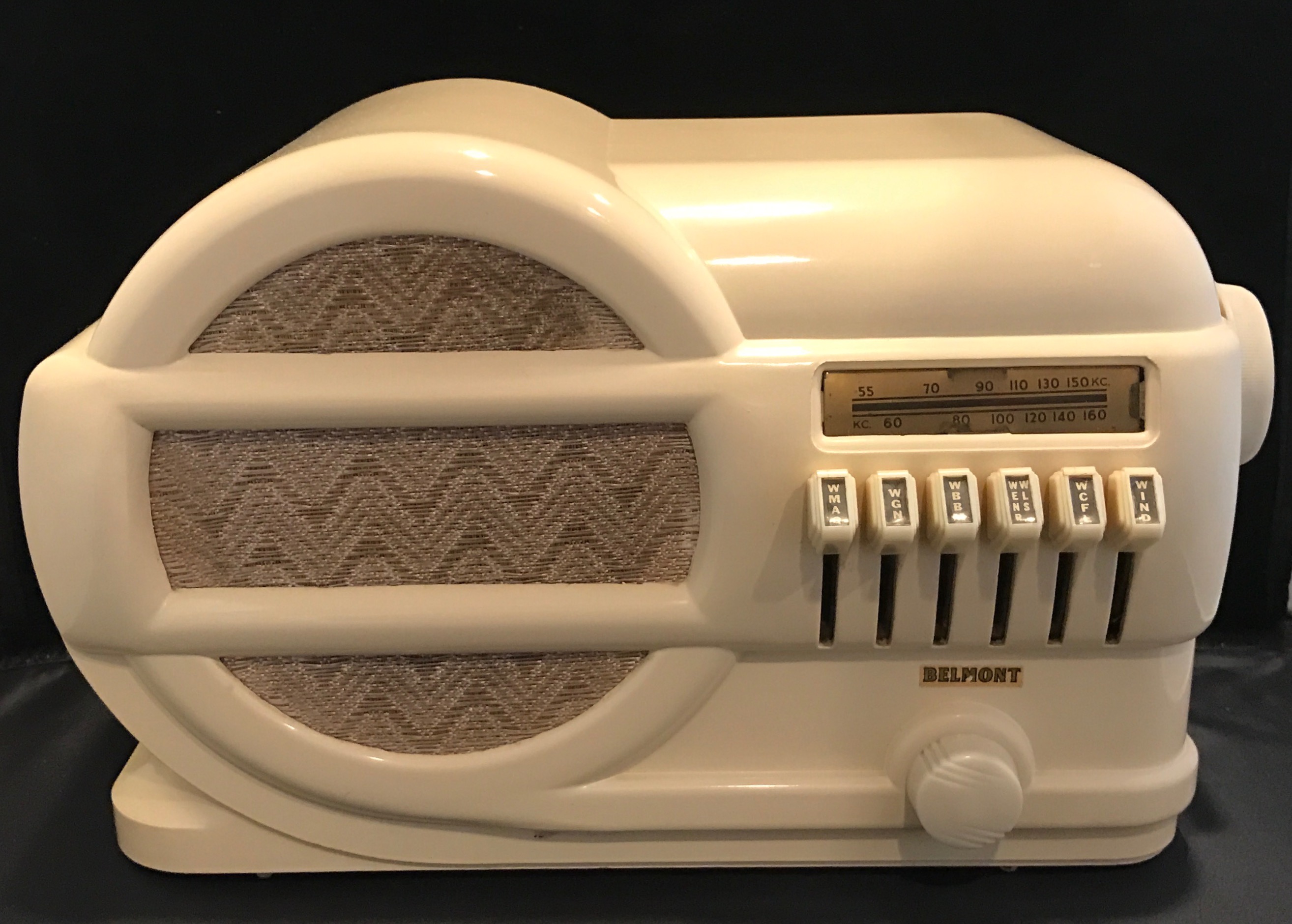
It has a very cool dial that’s obviously a Deco design.  These original knobs had some crazing, but most of it polished out, after I took those first photos.  The knobs go nicely with the dial and the grille cloth.  The BB-22 is about 10-inches wide, 7 high, and 5 deep.  It’s a good-sounding AM radio.  This Lafayette was purchased from Dick Bosch, along with these two near-mint radios…a Fada 845, and a Belmont 519.

img_7047

img_7077

You can see more of Dick’s collection in the article below.

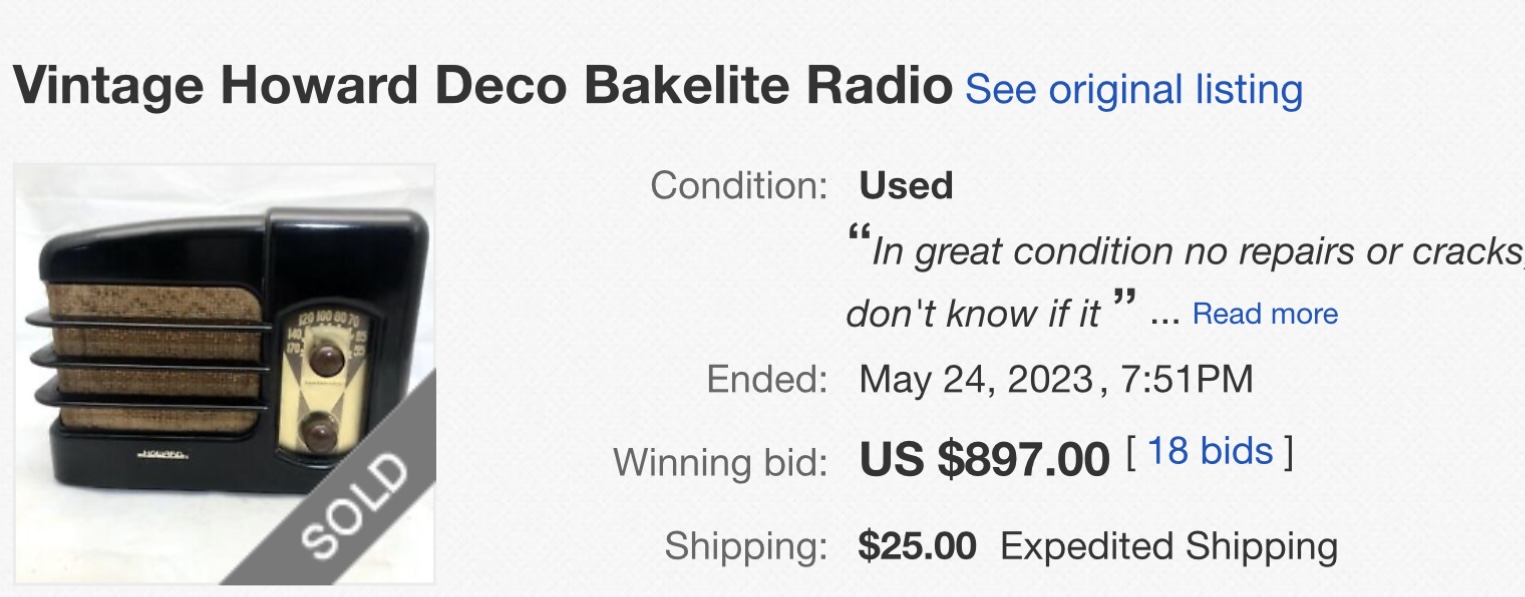
Update (May 2023):  Here’s another radio like the Lafayette, but was sold under the Howard label.  It was interesting to see the final sale price on eBay.  It really is a hard-to-find style.

The Dick Bosch Collection

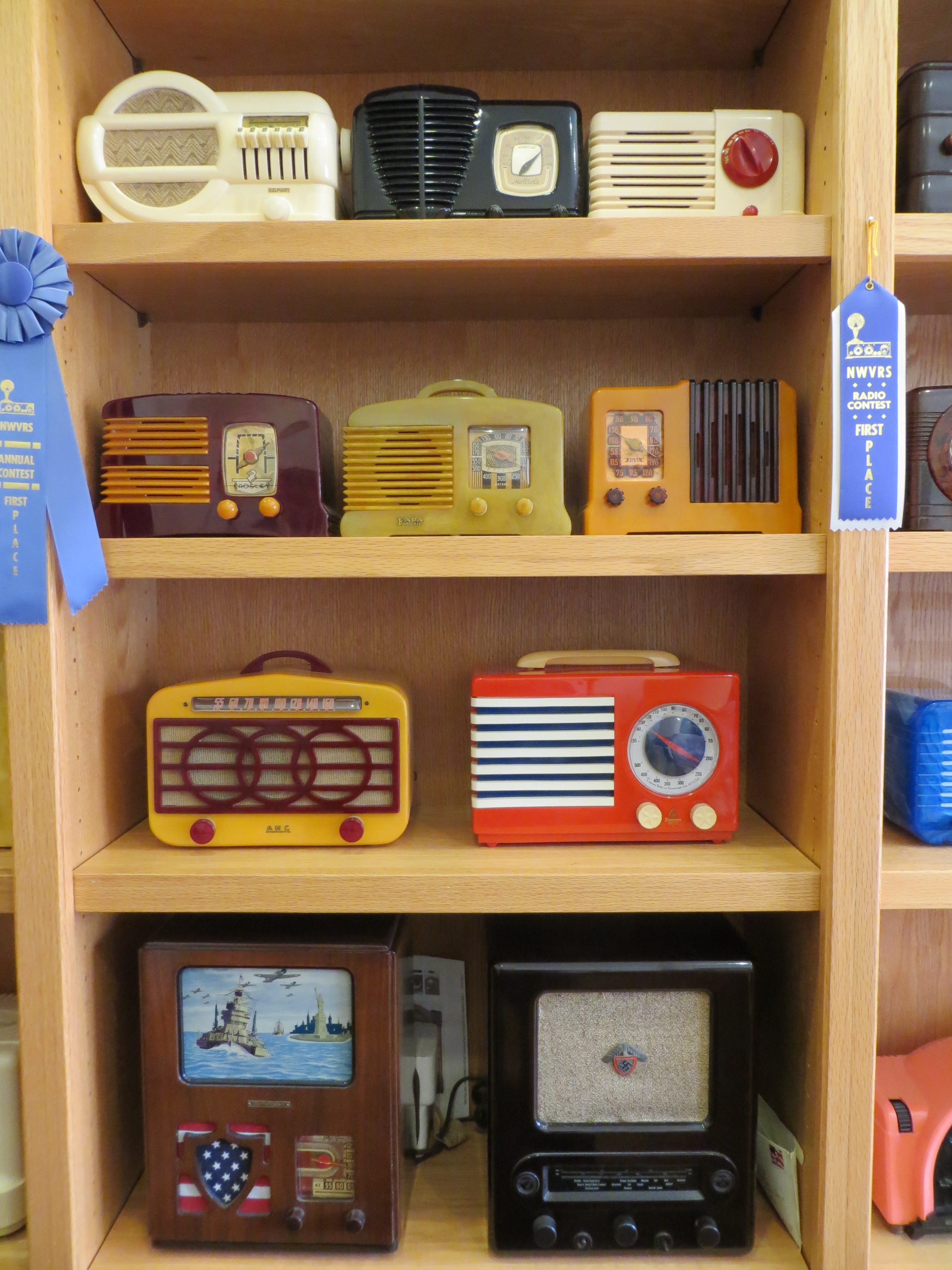
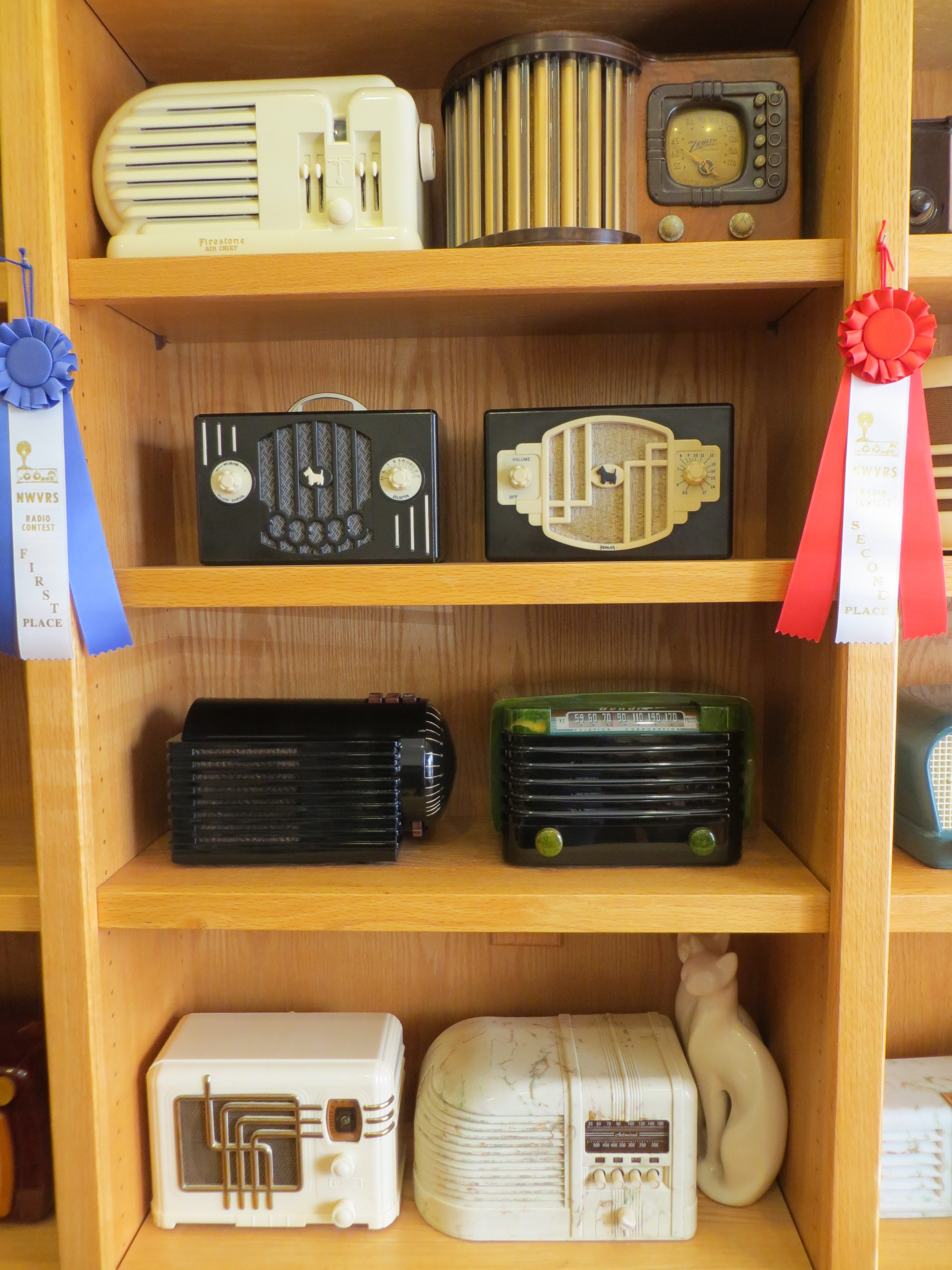
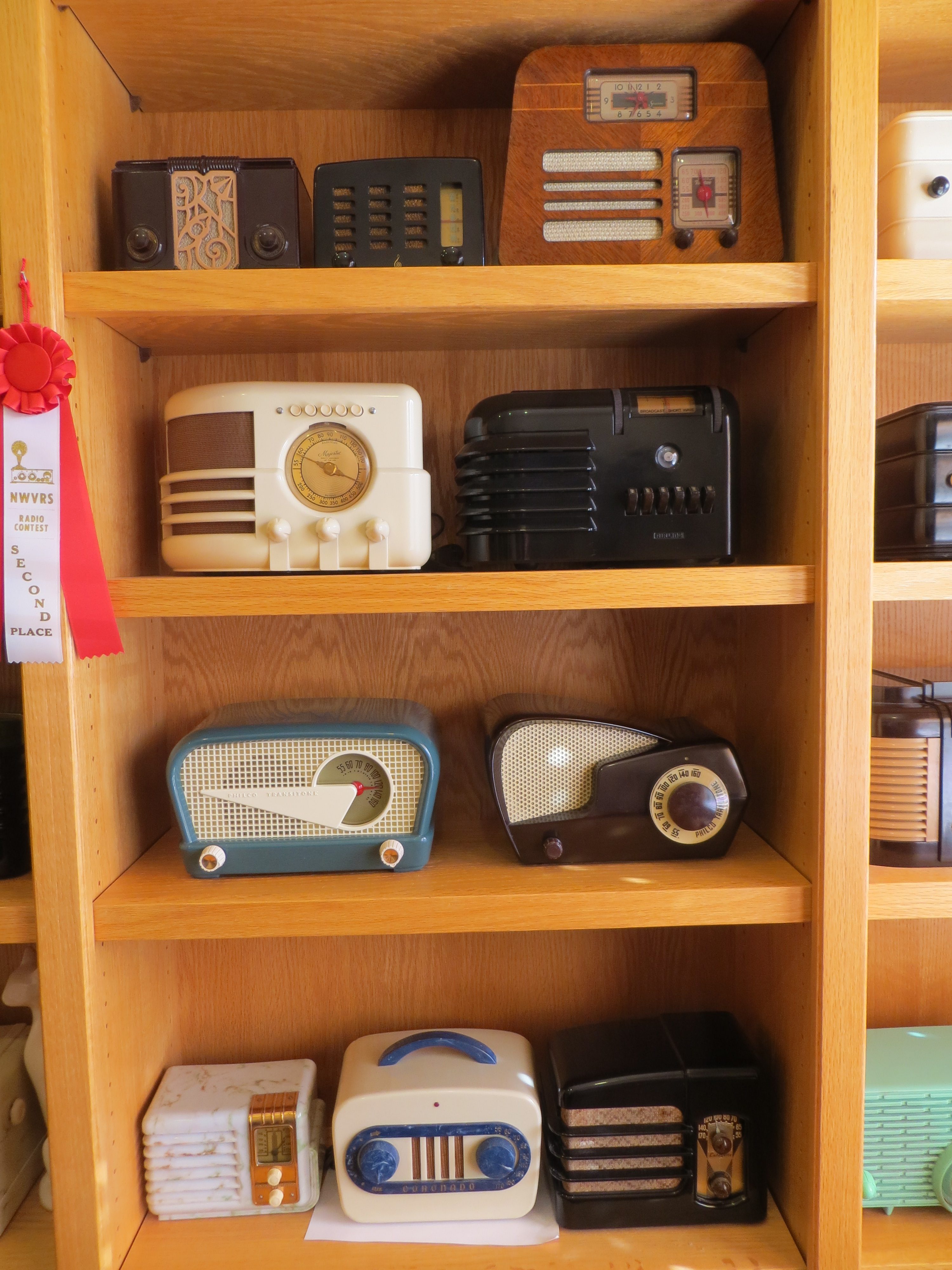
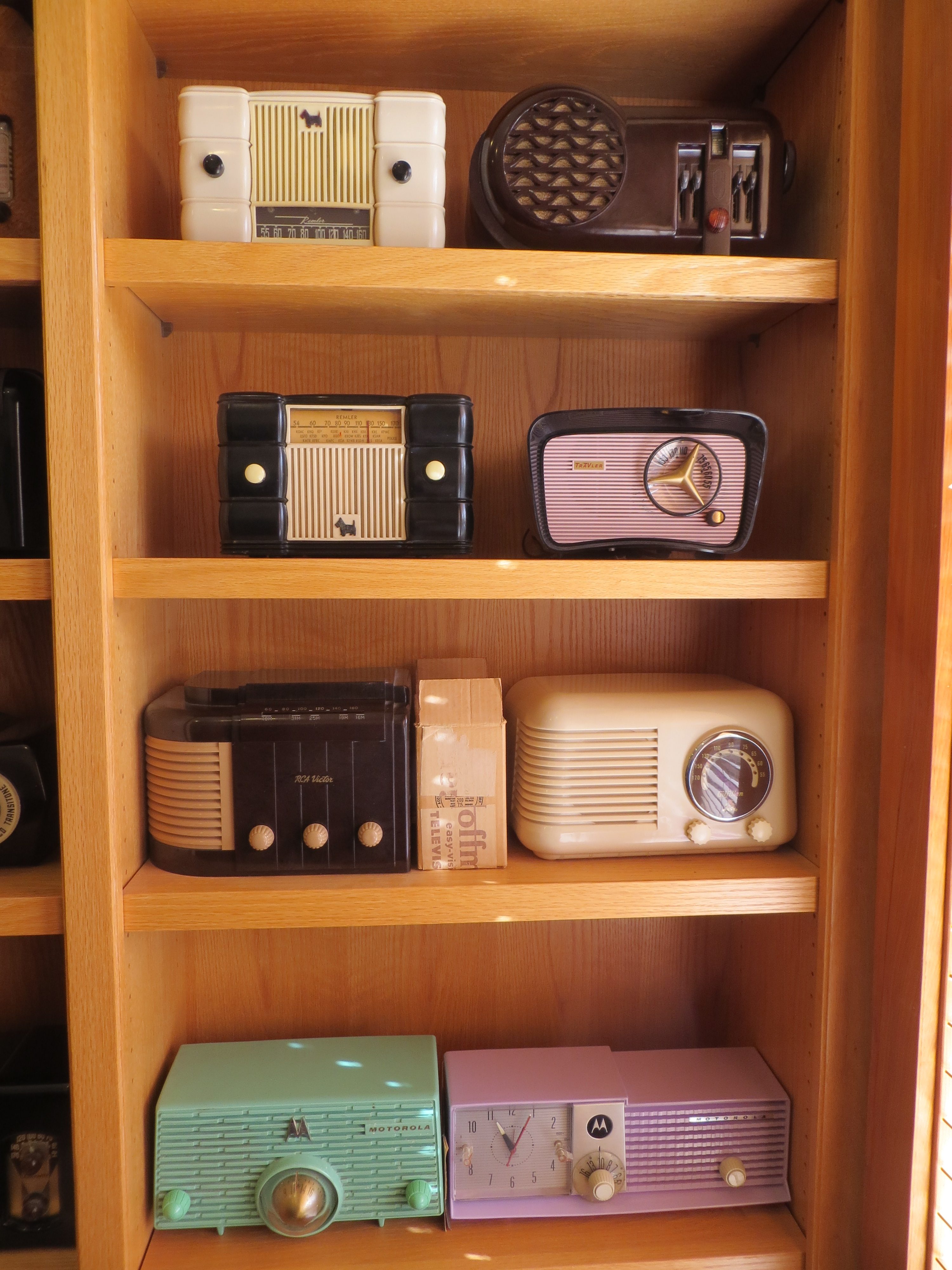
Most of the members of the Northwest Vintage Radio Society know Dick Bosch.  He’s a NWVRS member, a collector, a repairer, and a seller of radios.  Recently, he sold his personal collection.  If you weren’t lucky enough to see it in person, here are some photos.  The main display is in a neat set of bookshelves along his office wall.  Here’s a general shot, and the individual sections follow, so you can see the radios better.  In fact, clicking on the photos will not only make them larger, but clearer too.

img_4626img_4618img_4619img_4620img_4621img_4623img_4625

Definitely a lot of great radios!  The one blank spot on the shelves was normally occupied by a Beetle Plastic Addison A2, but that day, Dick was working on the electronics in his shop.  Dick and his wife Shirley, who live in Vancouver, Washington, collected many more radios over the years, and have sold over 400 of them that Dick restored.

img_3073

A couple of fun facts.  As a Marine in the early 1960’s, Dick worked at the top secret Area 51.  While visiting nearby Las Vegas at that time, he got to see Frank Sinatra and the rest of the “Rat Pack” perform.

Air King Skyscraper (Updates)

The 1933 Air King “Skyscraper” is so innovative and cool, it’s included as the first radio in John Sideli’s classic book on Catalin radios…even though it’s not Catalin!

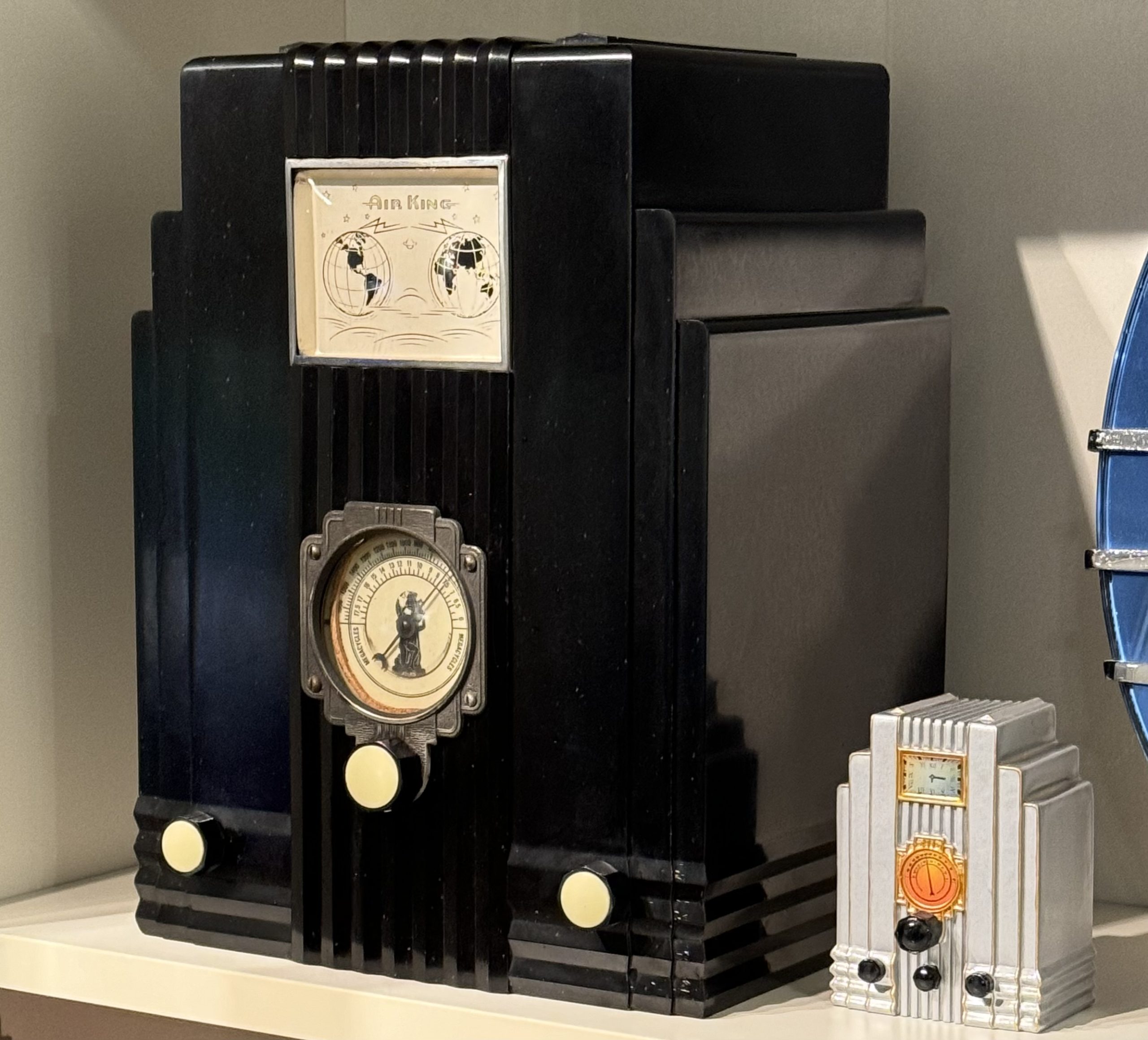
Some Air King Skyscrapers made of colorful Plaskon, like the five below, have gone for $40,000 to $50,000 each in auctions and private sales.

An eye-catching example of the crystalline finish in black:img_5111

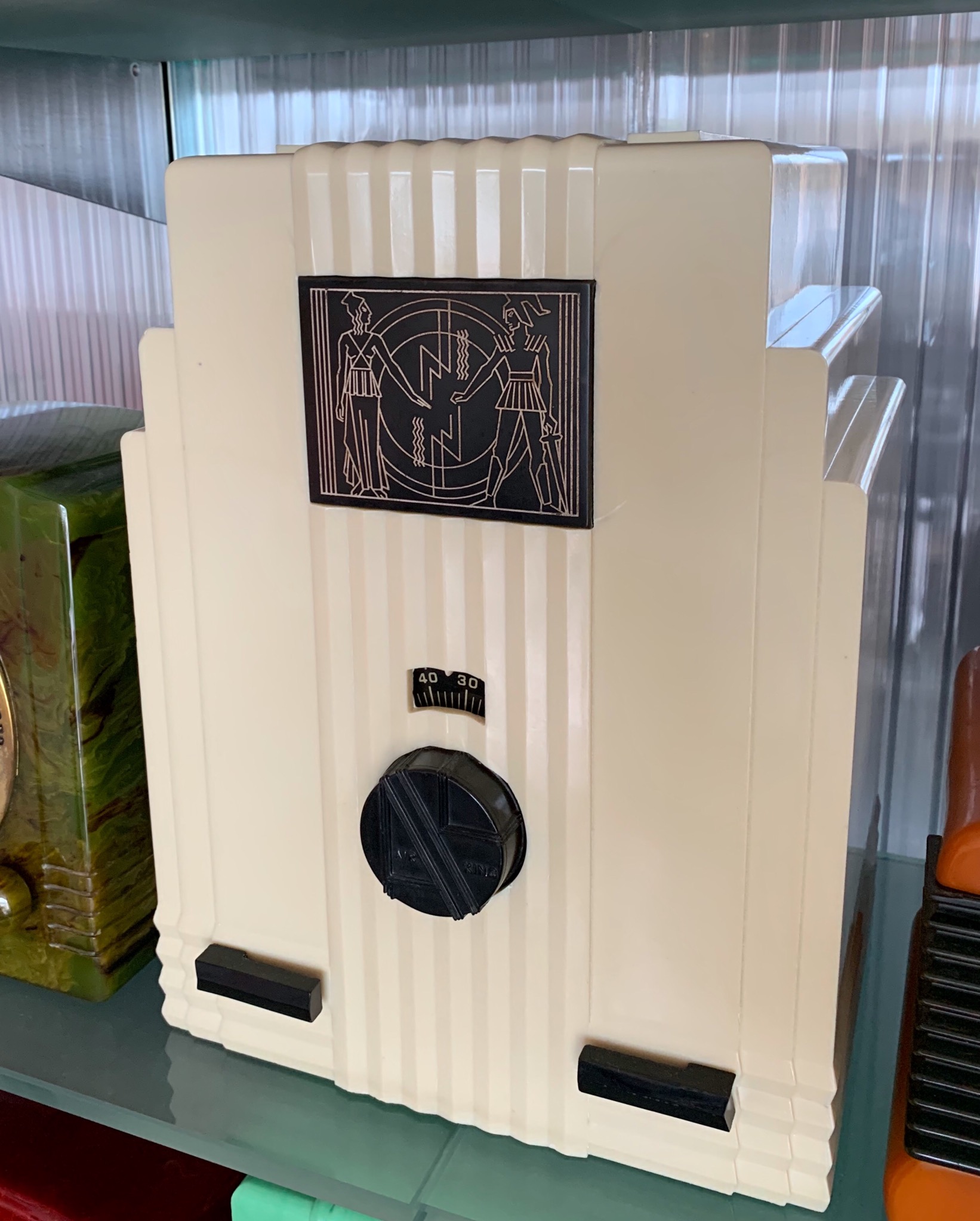
All of the above Air King Models 52 (Egyptian) & 66 (Clock or Globes) are part of Hugh & Jane Hunt’s impressive collection.

In 1933, it was unprecedented to offer radios in such a colorful array of choices.  According to my research…Plaskon versions were available in red, blue, green, yellow, lavender, ivory, and white.  Bakelite versions were available in brown and black.  And the crystalline finishes were only available in black and ivory…you saw the black above, and now the ivory:img_9813The crystalline finish is a smooth clear-coating that at times oxidized to show copper or gold tones.  Some collectors call it a “Flake Finish”.

fullsizerenderHere’s an elegant pure white Air King.  Thanks to GR, a collector in Florida, for the two impressive examples above.

A close up of the speaker grille on top:fullsizerender-1

img_6911This is my one lonely Air King Skyscraper.  It’s the Model 770 from 1937.  Not as cool as the 1933 versions, but still a nice collectible radio.  This model obviously has the speaker in the front, and has an added tuning eye.  Skyscrapers tend to look bigger in photos than in person.  They’re only about 12-inches high, 9-inches wide, and 7-inches deep.  According to Sideli, it was a major step forward to mold a plastic case of this size in 1933, when most radios were made of wood.  The design is by Harold Van Doren.  He had many excellent streamlined industrial designs in the 30’s, 40’s & 50’s, including the first two-door refrigerator.

Update:  Bought this black 1933 Air King Model 66 in November of 2024.

GR from Florida provides this wonderfully dramatic ivory and black “Egyptian” model:

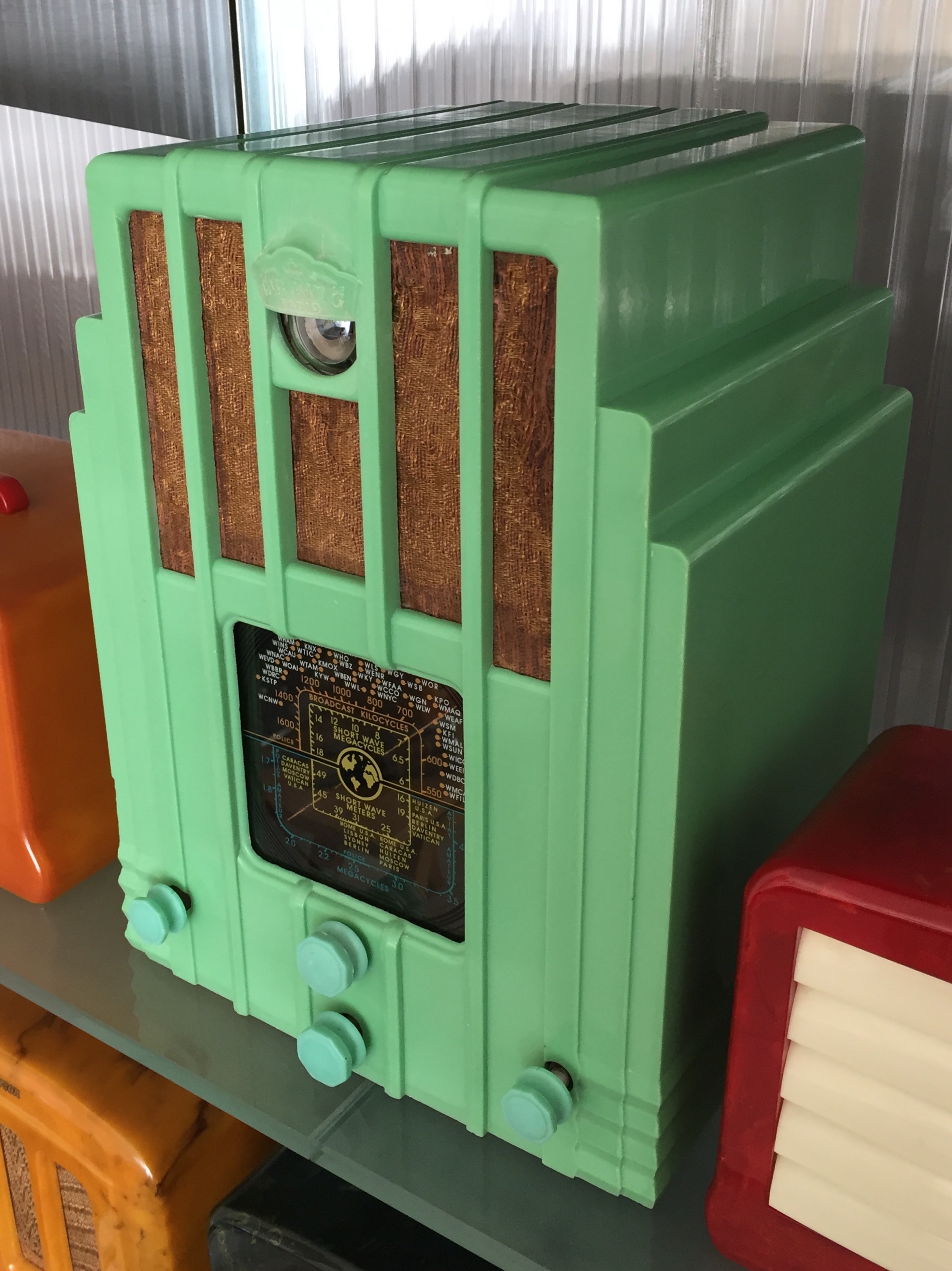
Here are three additional Model 770 finds by GR.  These are “didn’t know they existed!” versions.  Just check out the dazzling colors of these Plaskon (not painted) Skyscrapers.
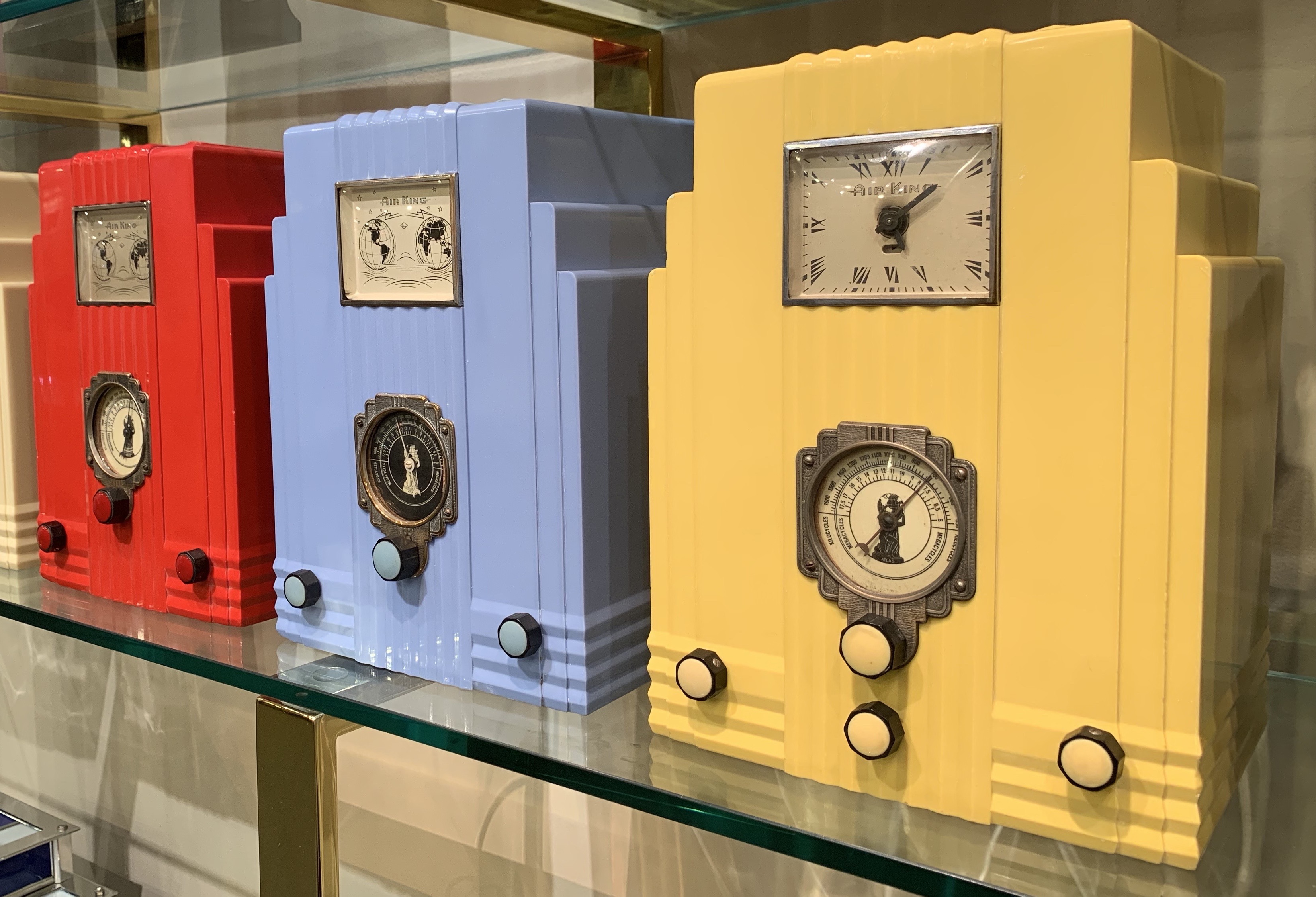
The vivid green Air King is an export model that GR discovered in South America.  The bright red 770 is the American version, but that red color makes it extremely rare.  And finally, look over that beautiful blue Plaskon Skyscraper.  It was made by Air King, but it was sold under the Lafayette brand.  That’s why “Air King” is not imprinted above the tuning eye, and why it has a different dial.  (You can click or touch any of the photos to check out the radios more closely.)

Thank you to GR for helping expand our knowledge of how many different versions of Air Kings were manufactured.

1939 Zenith World’s Fair Radio

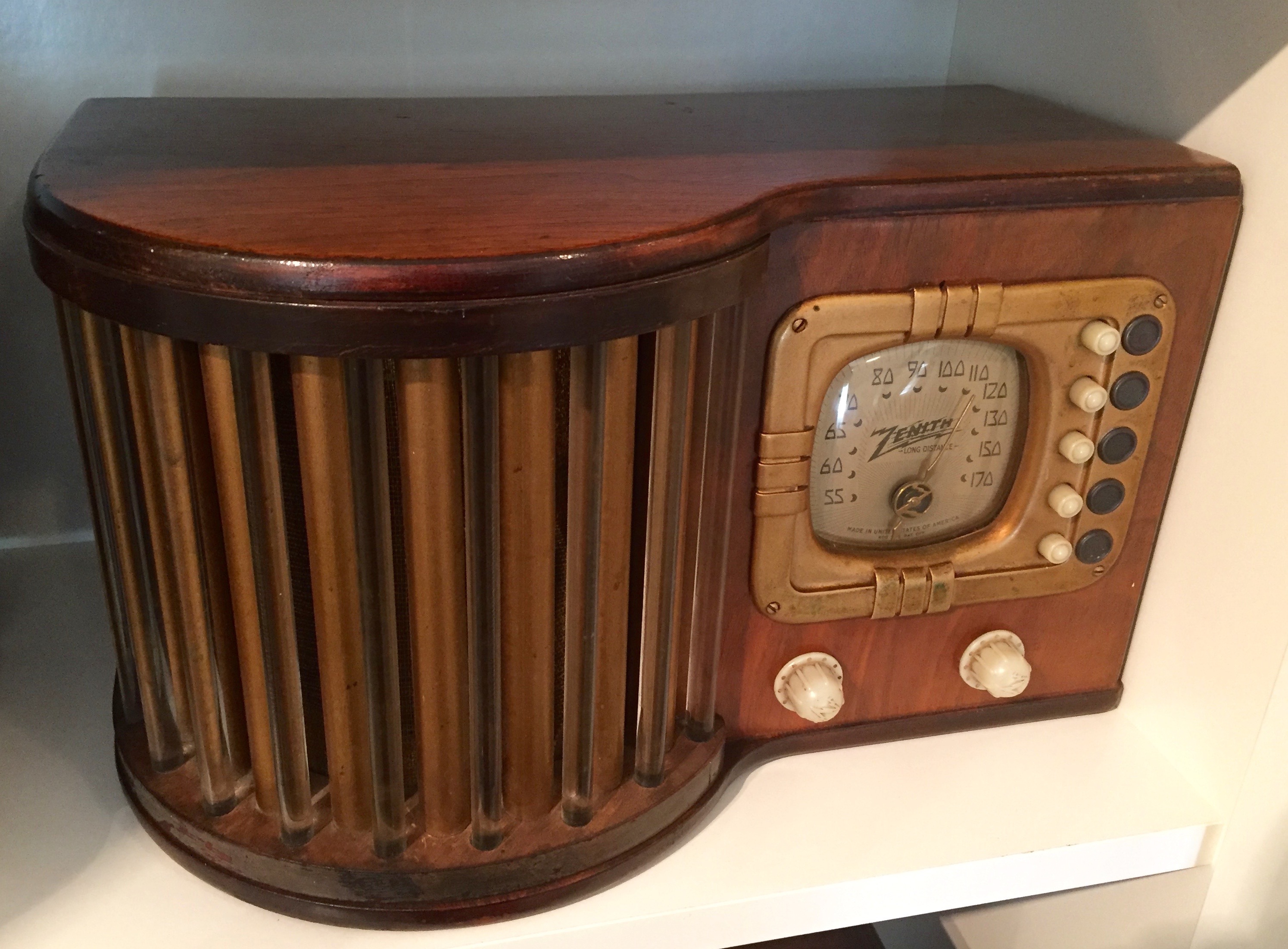
Recently, there was an estate sale in Cottage Grove, Oregon.  It included the radios of collector Glen Bricker.  Fortunately, I was able to purchase a special radio…a “Glass Rod” Zenith 5R-317 that had been designed for the 1939 World’s Fair.

image

You can see it looked okay.  The glass rods were all fine, but there was some wear on the wood finish and the dial surround, plus the gold pillars (that are between and farther back than the glass rods) were quite dull.  To bring the radio back to the look the designer intended, I turned once again to professional radio restorer, Gary Marvin.

image

Gary took the radio completely apart and prepared it for restoration.  Then he did a total refinishing of the wood and repainting of the gold surfaces.  Now this Zenith is the way it was meant to look, and it fits right into my collection.img_6574

Besides the cool glass rods feature, this model has the first example of electronic station tuning (rather than the common mechanical tuning).  Zenith called it Transcontinental Automatic Tuning.  It takes just a touch of a button, instead of a full mechanical push.

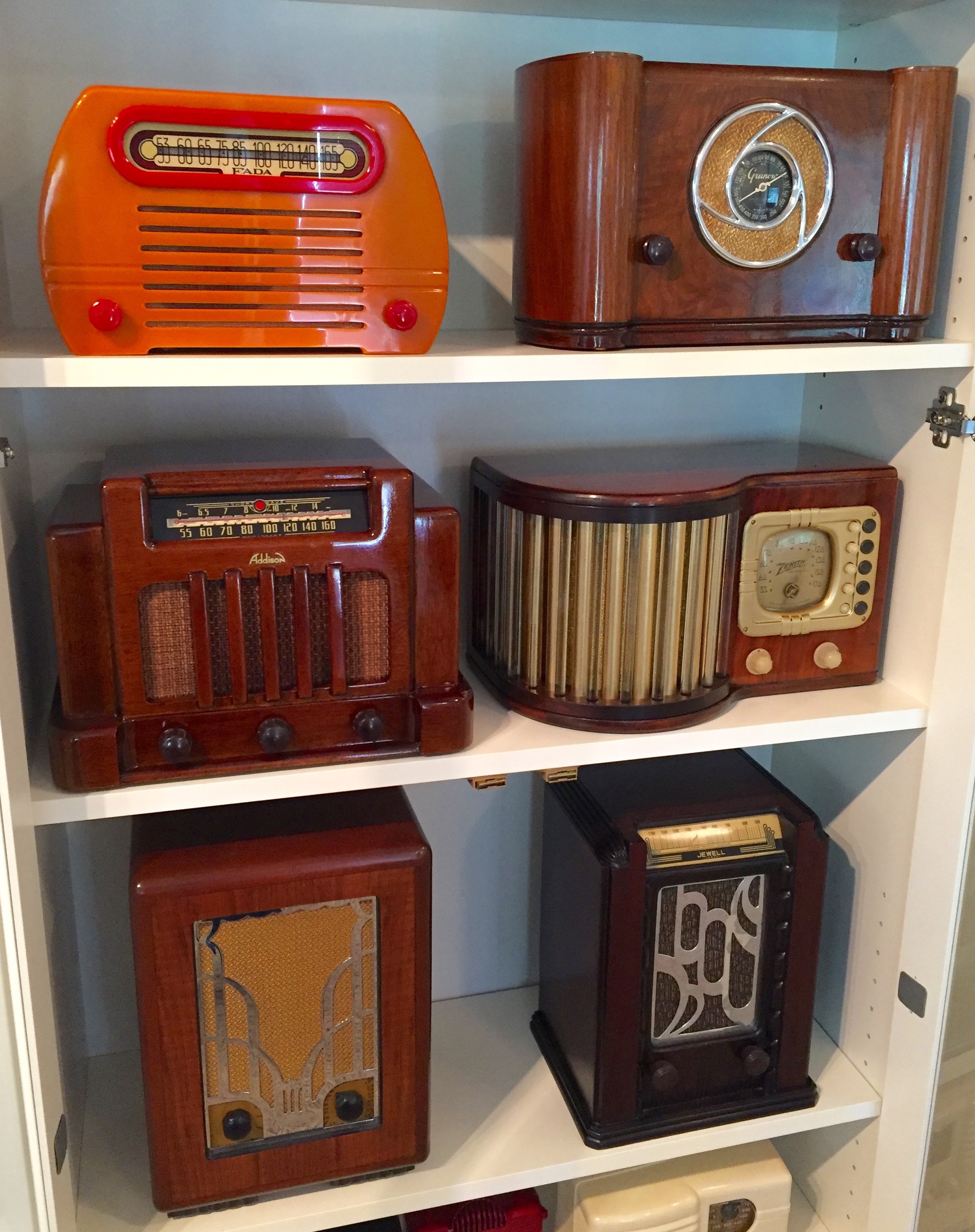
Early in my radio collecting days I had quite a few wooden radios, but then sold most of them to concentrate on Catalin and other plastics.  Since moving to the west coast, I’ve enjoyed adding some nice wooden radios to the collection once again.

Radio Collectors in Nebraska

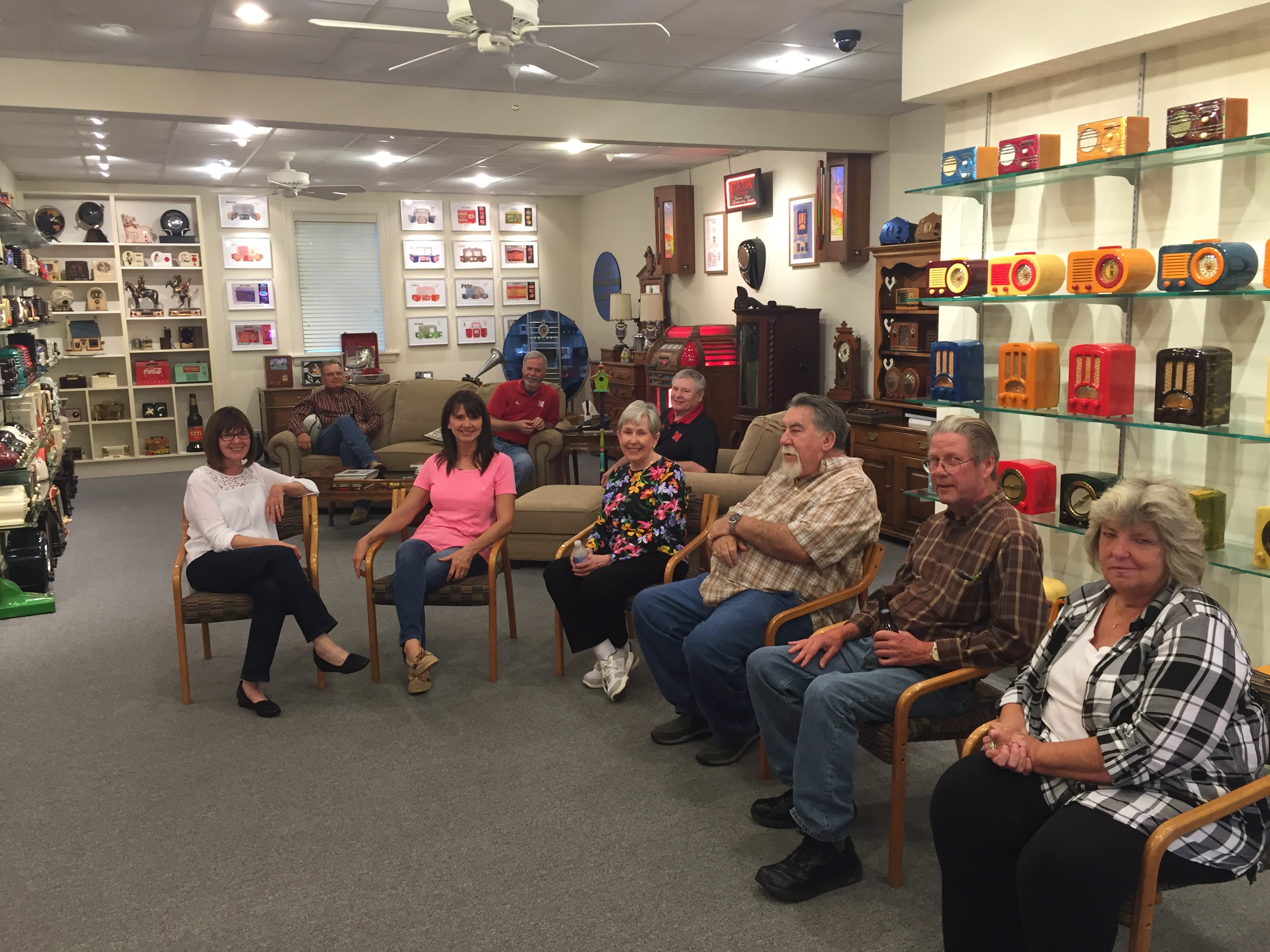
Another September trip to Nebraska, and a chance to see our radio collecting friends!img_6661

From left to right:  My wife Jeannette, brother-in-law Gary Wohlman, his wife Julie, Jon Walker, Jane Hunt, Hugh Hunt, Bob Smock, David O’Hanlon, and Bob’s wife Linda.

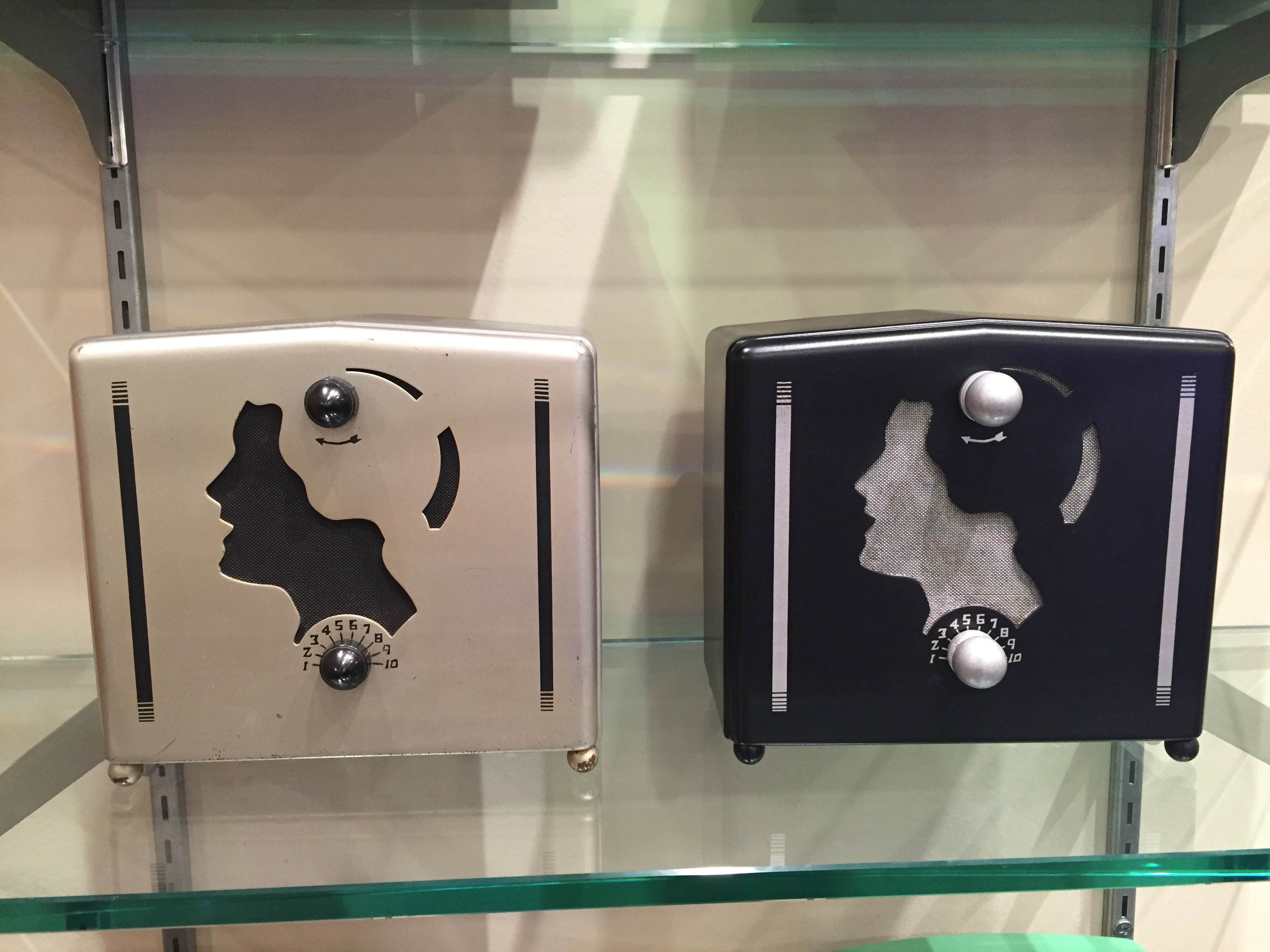
Hugh & Jane always host our get-togethers, and we get a chance to see their new radios, like these Stewart Warner “Silhouettes” or “Lady’s Head” radios.img_6650

The knobs on the left radio are Emerson knobs, so Jon Walker…who helps Hugh with needed repairs and detailing…will fabricate wooden knobs like the ones on the black version of the radio.  Of course the knobs will be black.  Here’s a photo of Jon and me.  (I swear I smiled right after the photo was taken.)  If you click to enlarge the photo and look closely at the gold Stewart Warner radio above our heads, you’ll see it also has the same type of knobs Jon will be making.img_6663

Jon is not only an excellent technician and handy person to know, he also has an extensive collection of Phonographs, Radios, Jukeboxes, and so much more!

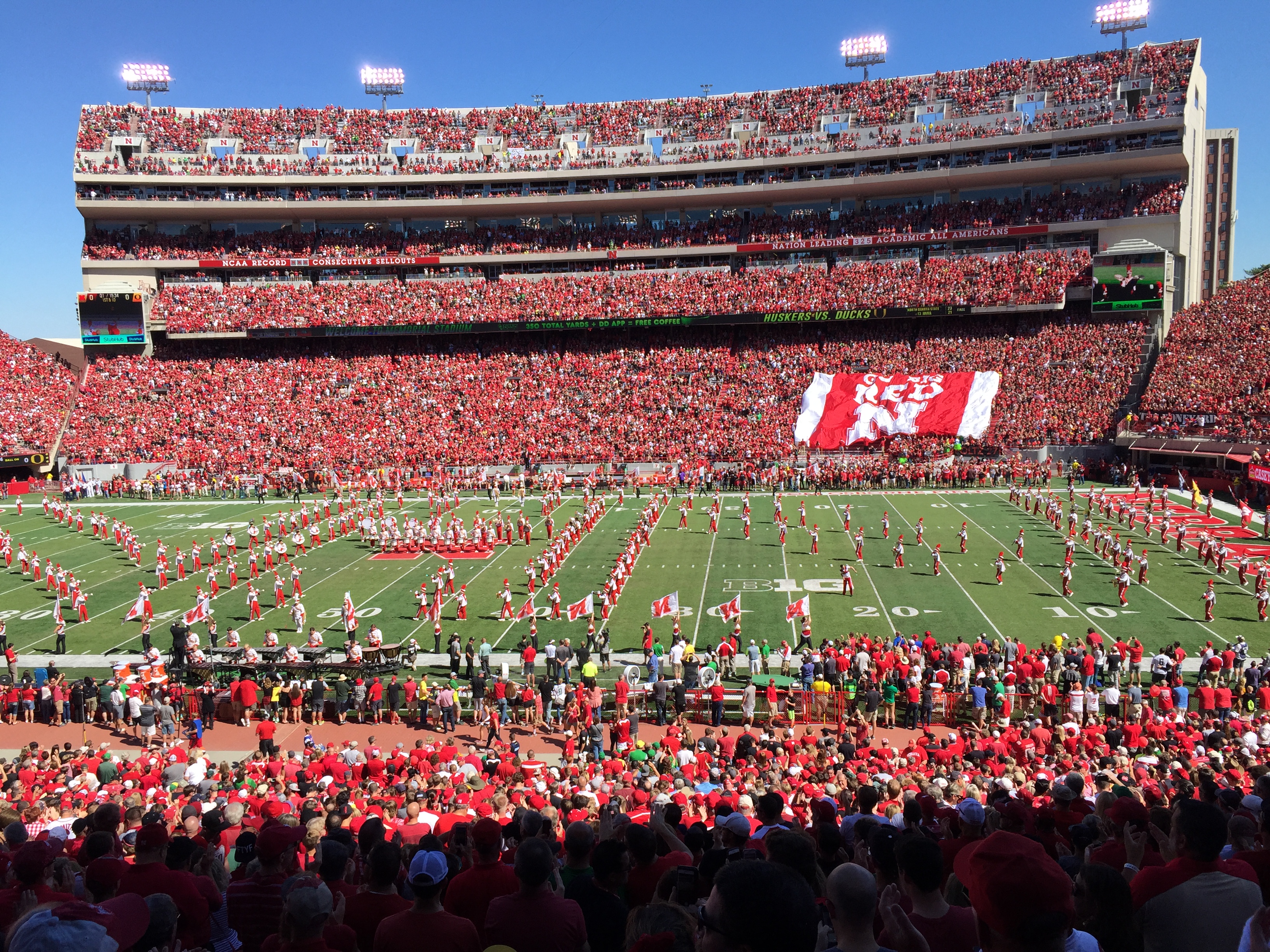
Hugh & Jane made the trip even more special for us.  They got us great tickets to the Oregon-Nebraska football game!  We’re fans of both teams, but had to go with my alma mater…Nebraska…for this one.  The Huskers won 35-32, but it could have gone either way.img_6692img_6685

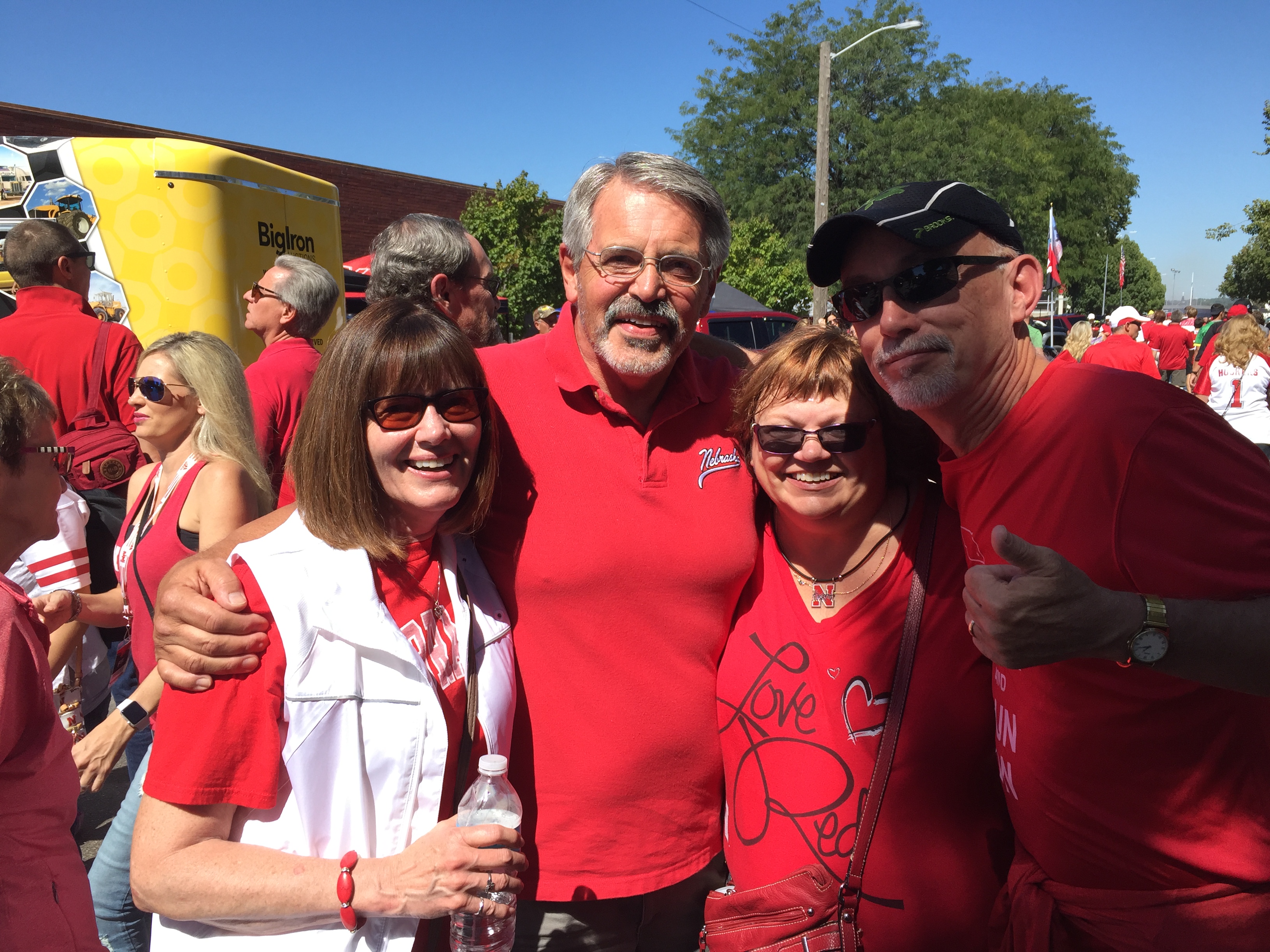
We attended the game with our good friends (and radio collectors) Al & Mary Kay Koontz…on the right…and ran into another friend, Avery Pickering.  All four of these friends have done Marathons and Half-Marathons together.

Here’s a photo taken in the early evening from the back deck of Hugh & Jane’s beautiful home in Blair…not far from the Missouri River.img_6647

It was a great visit!

Emerson 744B

As the mid-1950’s hit, radios began to look boxy as mass production and low cost replaced design.  The majority became rectangular, and although there are exceptions, many late ’50’s and ’60’s radio designs are boring and tend to look similar.

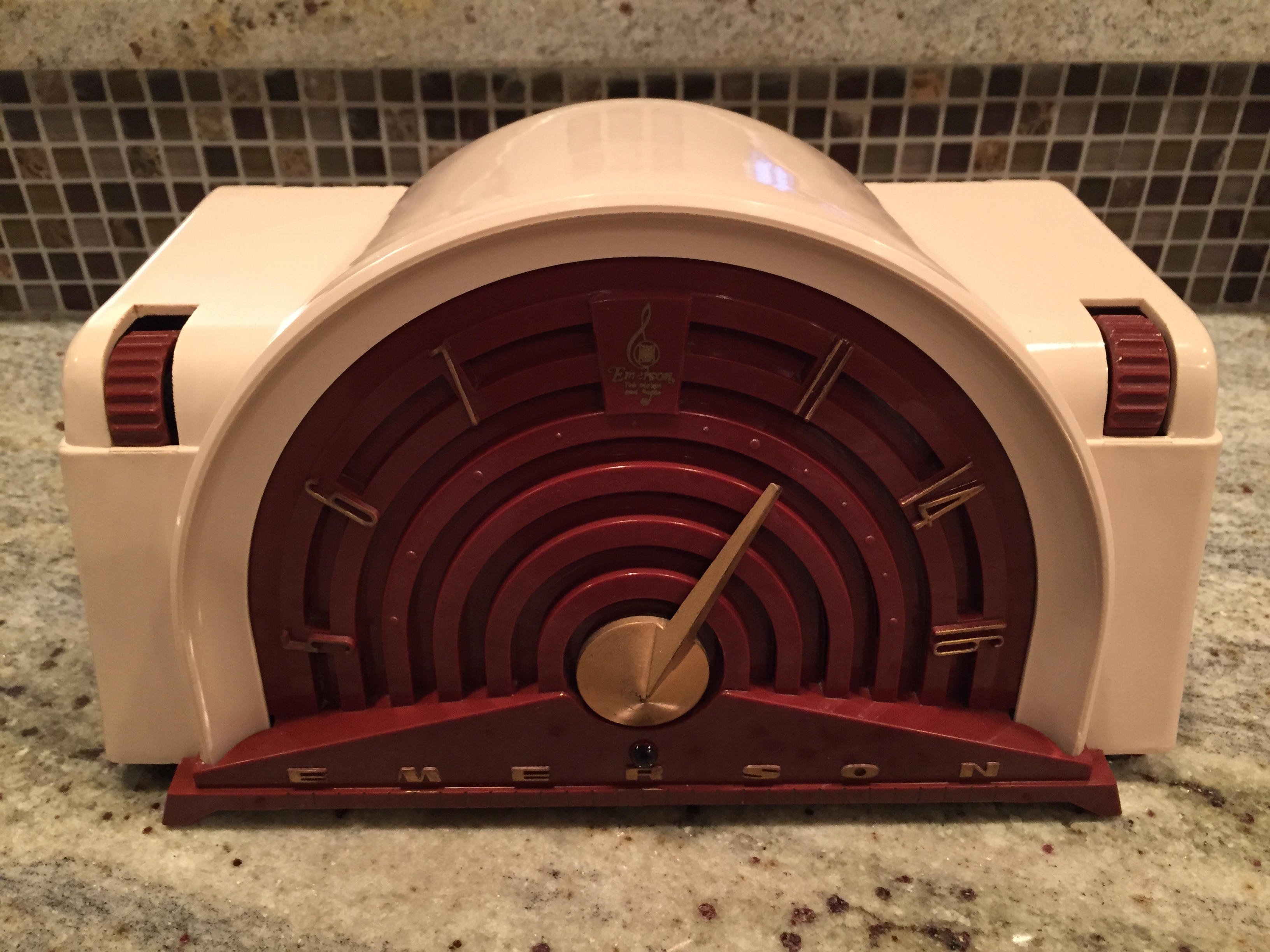
Just before that trend, came the 1954 Emerson 744B:P1080051IMG_1706OLYMPUS DIGITAL CAMERA

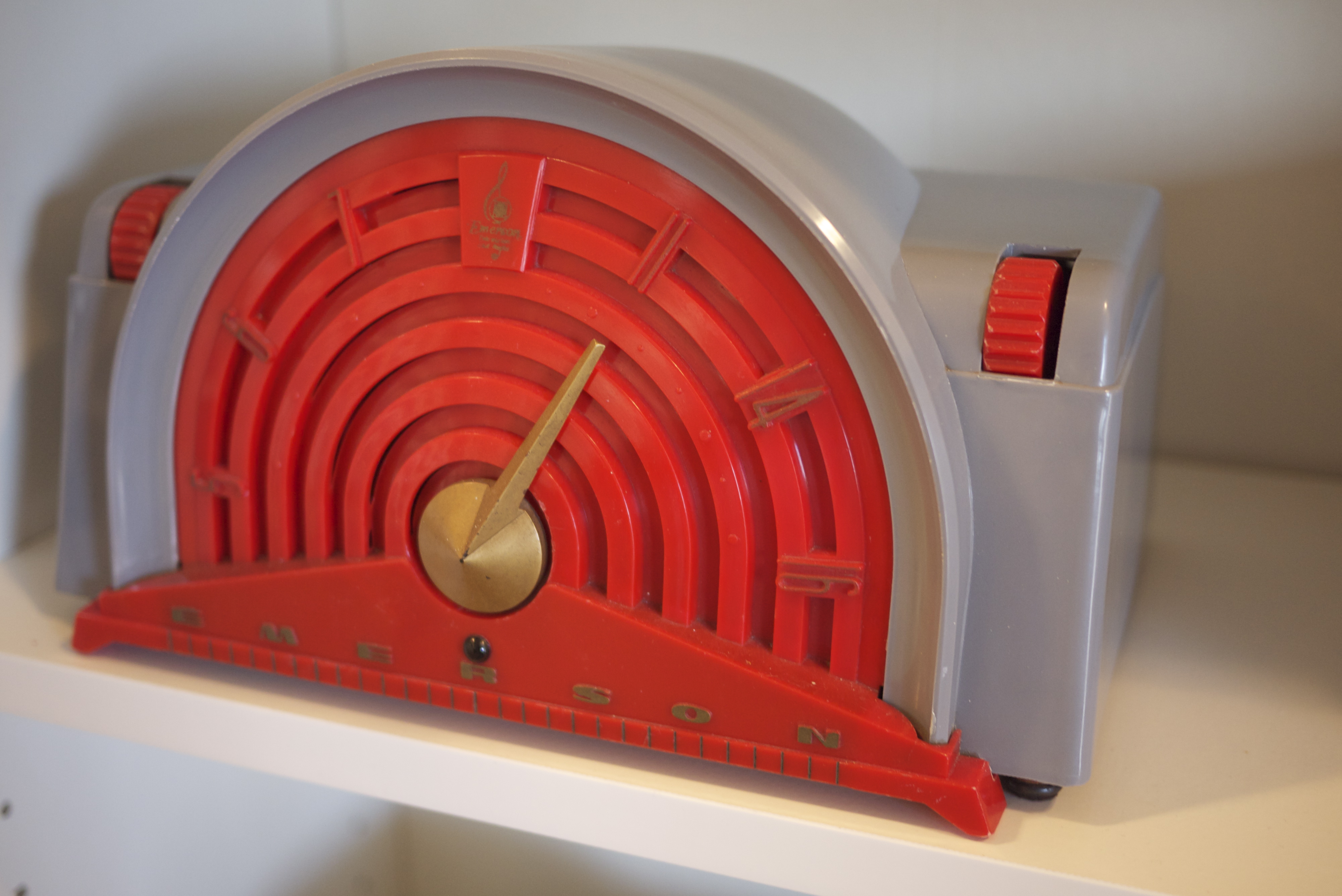
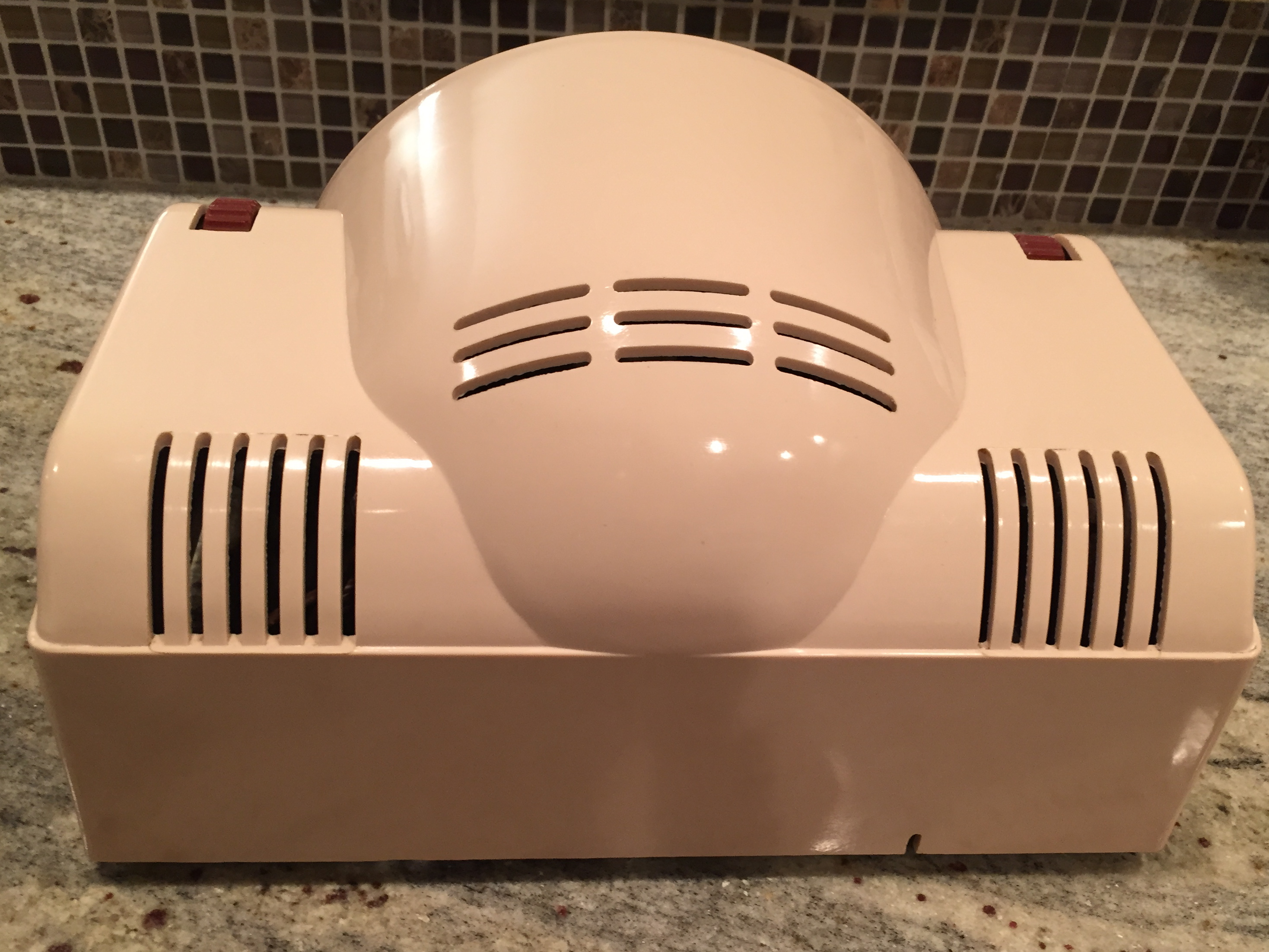
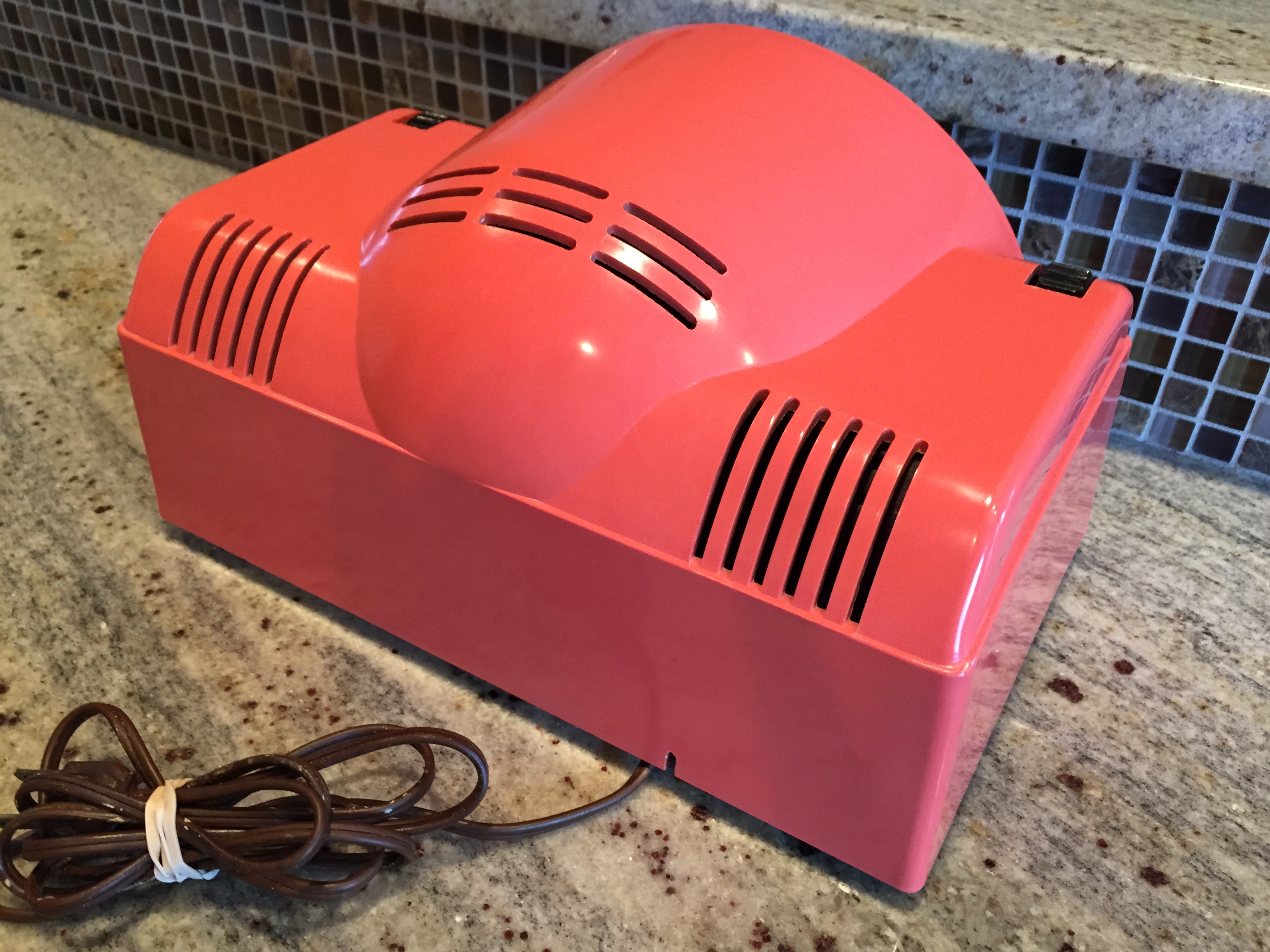
It’s not like any other radio.  The large plastic grille & pointer look like a giant speedometer.  The main part of the case reminds me of an orchestra shell…like the Hollywood Bowl.  And the back looks like it’s covering an electric turbine.

IMG_1714IMG_2337

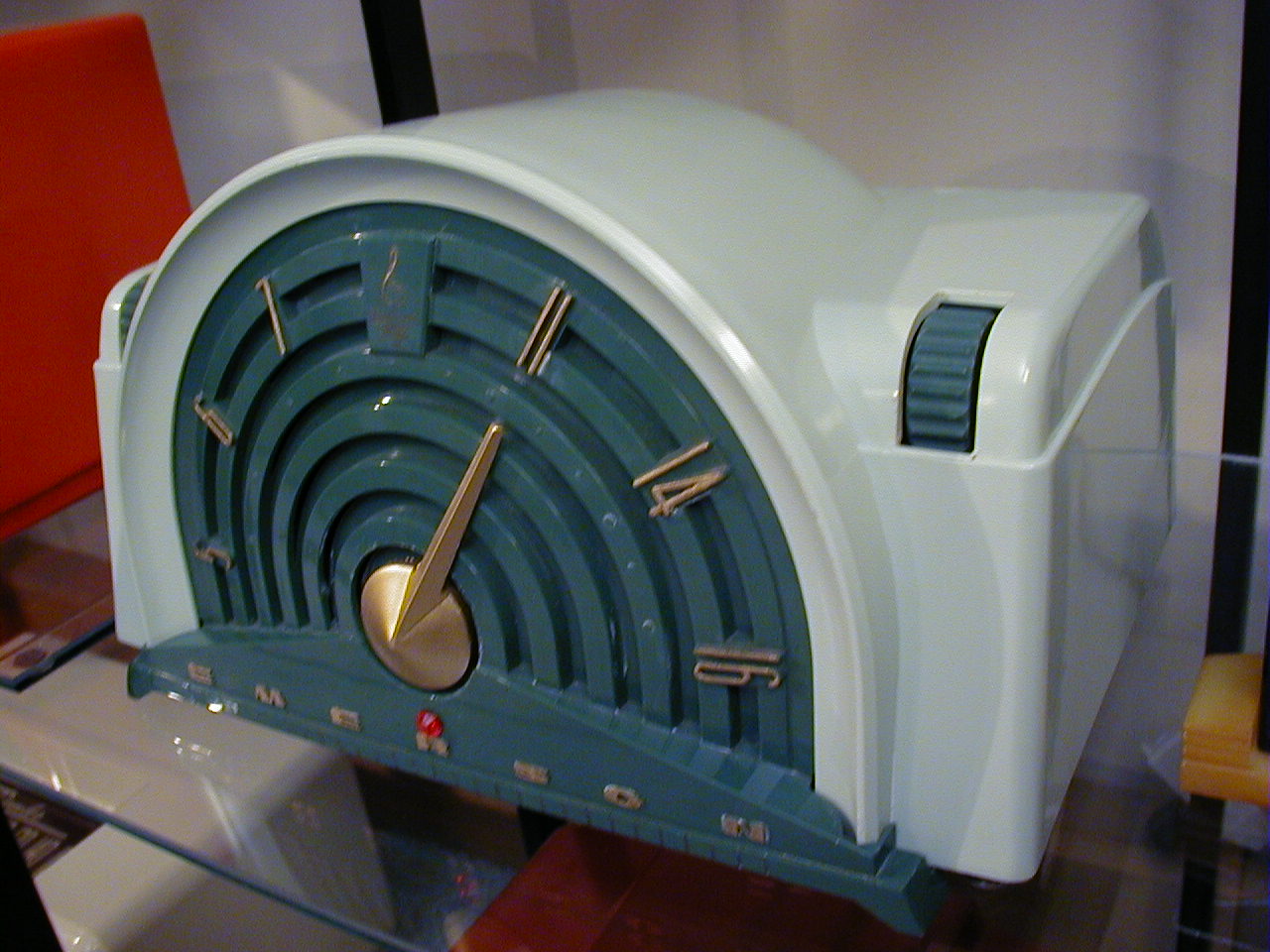
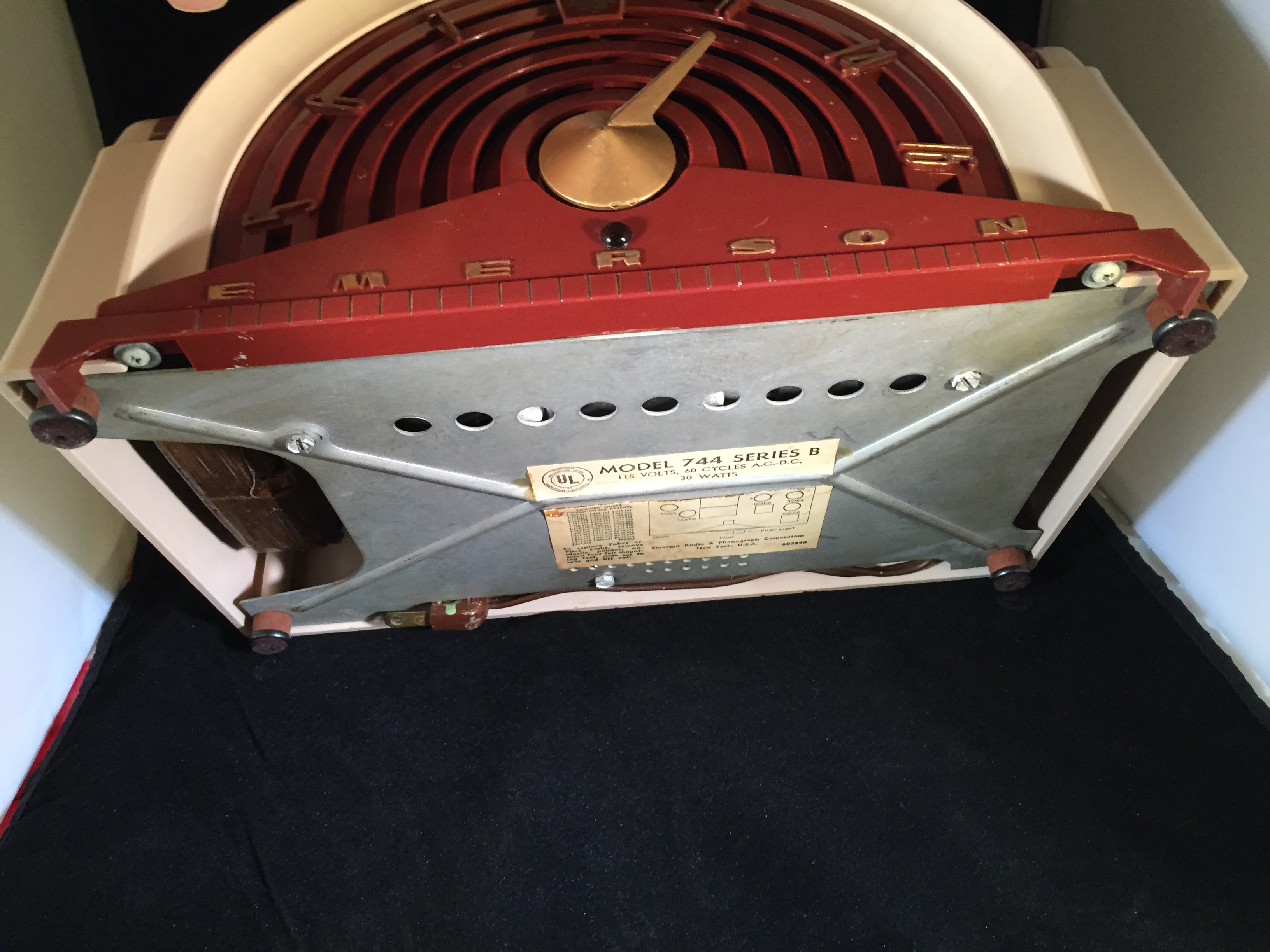
As you can see, the Emerson 744B came in a nice variety of colored Plaskon cases.  I always thought it would have made a great office desk radio, because the back would look cool to guests.  Most radios have cardboard backs, or even open backs, but this one looks good from every view.

IMG_3973IMG_1740

If you’d like to add a 744B to your collection, the first thing to look for is whether the faux front feet have broken off.  The design makes it easy to break those feet when the radio is serviced or even when the radio is just being handled.  In the above photo, you can see the thin plastic, and how the faux feet are not reinforced in any way.  Even though they look like feet, they cannot support the radio when the actual feet are removed for servicing.  Basically, the radios with unbroken feet are worth about double those without.